
What is a Share? Understanding Types of Shares with Examples
If you want to understand the Stock Market, you must first understand the word “Share”. Many students and investors find legal definitions confusing.
In this post, we will explain “Share” and its types in very simple language.
What is a Share?
A Company needs a lot of money to start a business. This money is called Capital. Often, one person cannot bring all the capital. So, the company divides its Total Capital into many small equal parts. Each single part is called a Share. A person who buys this share is called a Shareholder. The shareholder becomes a partial owner of the company.
Imagine a company named “ABC Ltd.” needs ₹ 10,00,000 (10 Lakhs). The company divides this amount into 1,00,000 parts of ₹ 10 each.
-
Total Capital = ₹ 10,00,000
-
Value of 1 Share = ₹ 10
-
If you buy 100 parts, you own 100 Shares.
Types of Shares
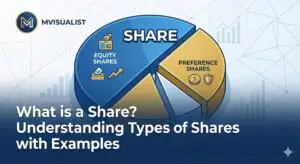
According to the Companies Act, 2013, a company can issue only two types of shares:
-
Preference Shares
-
Equity Shares
Let’s understand them in detail.
1. Preference Shares
As the name suggests, these shareholders get a “Preference” (first priority). They are like VIP guests in a wedding. They get two main benefits over others:
-
Payment of Dividend: They get their profit share (dividend) before equity shareholders.
-
Repayment of Capital: If the company closes down (winds up), they get their money back before equity shareholders.
However, Preference Shareholders usually do not have voting rights. They cannot vote on company management decisions.
Types of Preference Shares:
-
Cumulative Preference Shares: If the company does not make a profit this year, the unpaid dividend adds up. The company must pay it next year.
-
Non-Cumulative Preference Shares: If there is no profit, the dividend is lost. It does not add up.
-
Participating Preference Shares: They get a fixed dividend PLUS a share in extra surplus profits left after paying equity shareholders.
-
Non-Participating Preference Shares: They get only their fixed dividend percentage. Nothing extra.
-
Convertible Preference Shares: These shares can be converted into Equity Shares after a specific time.
-
Redeemable Preference Shares: The company returns the money to shareholders after a fixed period (e.g., 10 years). Note: In India, companies cannot issue Irredeemable Preference Shares.
2. Equity Shares
Equity Shares are also known as Ordinary Shares. These shareholders are the real owners of the company. They take the maximum risk and get the maximum reward.
-
No Fixed Dividend: The dividend is not fixed. If the profit is high, they get more. If there is no profit, they get nothing.
-
Voting Rights: They have the right to vote in meetings. They select the directors of the company.
-
Last Claim: If the company closes, they get their money back only after paying all debts and Preference Shareholders.
Types of Equity Shares:
-
Equity Shares with Uniform Voting Rights: This is the most common type. One Share = One Vote.
-
Equity Shares with Differential Voting Rights (DVR): These shares give different rights. For example, a shareholder may get a higher dividend but lower voting rights. Tata Motors is a famous example of a company that issued DVR shares.
Quick Difference: Equity vs. Preference
| Point | Equity Shares | Preference Shares |
| Dividend | Not fixed. Depends on profit. | Fixed rate (e.g., 10%). |
| Voting Right | Yes. They can vote. | Generally No. |
| Risk | High Risk. | Low Risk. |
| Refund of Capital | Paid last. | Paid before equity. |
| Status | Real Owners. | Hybrid (Owner + Creditor). |