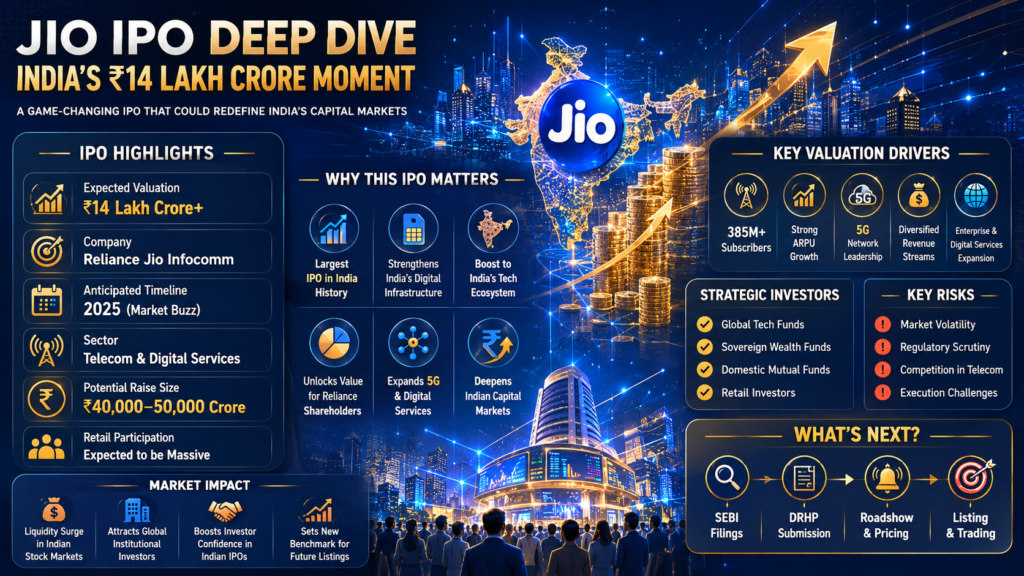
India’s ₹14 Lakh Crore
Moment
Mukesh Ambani is “advancing steadily towards listing” Jio Platforms — the company with 524 million subscribers, 52% EBITDA margins, and a valuation that would reorder India’s equity landscape. This is everything you need to know before the DRHP drops.
In April 2024, Mukesh Ambani stood before Reliance Industries shareholders and made a promise that had been a decade in the making: Jio Platforms — the digital and telecom giant he had built from nothing into India’s most dominant connectivity business — would list on the stock exchanges. The words were precise: “advancing steadily towards listing.”
Those four words carry the weight of what could be India’s largest-ever IPO. At the upper end of the valuation band being discussed by investment banks — Goldman Sachs, Jefferies, and Citi among them — Jio Platforms would be worth somewhere between ₹10.8 lakh crore and ₹14.1 lakh crore, or roughly $130–170 billion. That would place it ahead of Bharti Airtel and within striking distance of Reliance Industries itself — a parent potentially rivalled by its own child.
Originally targeted for the first half of 2026, the IPO timeline has shifted. Geopolitical turbulence in West Asia, a sharp risk-off move by foreign institutional investors through March 2026, and Reliance’s own preference for launching into a receptive market have pushed the window toward the second half of FY27. The DRHP filing — the formal starting gun — is now expected sometime in H2 2026, using Jio’s freshly completed FY26 numbers.
But make no mistake: this is not a delay. It is a calibration. The story Jio will tell to global investors when it does list is more compelling now than at any point in its history.
Mukesh Ambani reiterated post Q4 FY26 results that Jio Platforms is “advancing steadily towards listing,” making this set of results — with full-year EBITDA growth of 19% and margins expanding to 51.9% — an important valuation anchor for the forthcoming public offering.
From Zero to 524 Million: How Jio Changed Everything
The story of Jio begins not in 2016, but in 2010, when Reliance Industries quietly acquired Infotel Broadband and gained a nationwide spectrum footprint. For six years, Ambani and his team built in silence — laying fibre, erecting towers, negotiating spectrum, and developing the technology stack that would eventually detonate like a depth charge under the Indian telecom market.
On September 5, 2016, Jio launched commercially — offering free voice calls and near-zero-cost data to an India that was then ranked 155th in the world in mobile data consumption. Within 83 days, Jio had 50 million subscribers. Within a year, India had leapfrogged to the top of the global mobile broadband rankings, overtaking the United States and the United Kingdom. It was not an evolution. It was a rupture.
The competitive casualties were severe. Aircel shut down. Idea and Vodafone merged to survive. BSNL became a ward of the state. Tata Teleservices exited. From nine operators, India’s market collapsed to three private players — Jio, Bharti Airtel, and Vodafone Idea — plus BSNL. Jio had restructured an entire industry through pricing alone.
India’s average mobile data cost fell by more than 95% between 2016 and 2020. India crossed the 1 billion internet user milestone in November 2025. India’s broadband connections reached nearly 945 million by December 2024. Jio is widely credited as the single greatest accelerant of India’s digital economy.
Today, Jio is not a telecom company that also has digital services. It is a digital platform company that happens to own a telecom network — one of the largest 4G/5G networks in the world, with 524 million subscribers, 27.1 million home broadband connections, and a deepening stack of digital applications, enterprise services, AI infrastructure, and fintech offerings.
Beyond the SIM Card: Jio’s Digital Empire
The crucial investor insight — and the one that justifies the premium valuation multiples being discussed — is that Jio’s telecom subscriber base is the foundation, not the ceiling. It is a distribution platform for a growing array of digital products that generate incremental revenue without proportional incremental cost.
The Numbers That Will Sell the Story
Jio Platforms closed FY26 on a record note. Every metric that an equity investor scrutinises — revenue growth, profitability, margins, user engagement — moved in the right direction. The story has decisively shifted from “subscriber acquisition” to “monetisation at scale”.
Revenue from Operations (₹ Crore)
Net Profit — PAT (₹ Crore)
EBITDA Margins: The Story Within the Story
Jio’s EBITDA margin of 51.9% in FY26 — up from 50% in FY25 — is a number that deserves emphasis. For a company at this scale, expanding margins while also growing revenue at double-digit rates signals the arrival of operating leverage: the point at which incremental revenue flows through to the bottom line at a higher rate than incremental cost. Jio’s full-year EBITDA reached ₹76,255 crore in FY26 — an 18.87% increase year-on-year.
ARPU: The Monetisation Dial
Average Revenue Per User is the variable investors will track most closely after listing. Jio’s ARPU rose to ₹214 per month in Q4 FY26, up from ₹206.2 a year earlier. This improvement was driven by the residual effects of the July 2024 tariff hike, a richer subscriber mix as low-value users churn off, and increased adoption of premium digital services. The key benchmark: Bharti Airtel’s ARPU is approximately ₹259 — suggesting meaningful further headroom for Jio as its subscriber mix matures.
5G and Data: The Growth Engine
Data traffic in Q4 FY26 surged to 66 Exabytes — a 35% increase year-on-year. Jio added 75 million 5G net subscribers in FY26, taking its total to 268 million — more than 51% of its entire user base. This is the world’s largest 5G subscriber base outside China, and it is the platform on which Jio will build its next decade of monetisation — through higher-data plans, premium content bundles, enterprise 5G services, and eventually AI-powered applications.
Who Is Selling, and How Much?
One of the most commonly misunderstood aspects of the Jio IPO is its structure. This is not a fresh issue — Jio is not raising new capital to fund its operations or expansion. It already generates more than enough cash from operations for that purpose. Instead, the offering is expected to be structured primarily or entirely as an Offer for Sale (OFS), in which a consortium of global investors who bought stakes in Jio Platforms in 2020 trim portions of their holdings.
| Investor | Category | Pre-IPO Stake | Post-IPO (Est.) | Investment Year |
|---|---|---|---|---|
| Meta Platforms (via Jaadhu Holdings) | Big Tech | 9.98% | ~9.1% | 2020 |
| Alphabet / Google | Big Tech | 7.73% | ~7.0% | 2020 |
| KKR | Private Equity | ~2.32% | Partial trim | 2020 |
| ADIA (Abu Dhabi) | Sovereign Fund | ~1.16% | Partial trim | 2020 |
| Mubadala (Abu Dhabi) | Sovereign Fund | ~1.85% | Partial trim | 2020 |
| Vista Equity Partners | Private Equity | ~2.32% | Partial trim | 2020 |
| Reliance Industries Ltd | Promoter | ~67.5% | Majority retained | Founding |
Critically, neither Meta nor Google is making a full exit. They are trimming approximately 0.85–0.73 percentage points of their stakes respectively. This is a significant signal: two of the world’s most sophisticated technology investors, who committed capital at a Jio valuation of roughly $60–65 billion in 2020, are retaining the vast majority of their holdings — implicitly endorsing the $130–170 billion IPO valuation.
The aggregate sell-down across all investors is expected to equal approximately 2.5–3% of Jio Platforms’ total equity. At the indicated valuation band, that translates to an issue size of ₹40,000–₹50,000 crore ($4–5 billion) — making it one of India’s largest public offerings even with minimal dilution.
India’s market regulator reduced the minimum public float requirement for companies with a post-issue market cap exceeding ₹5 lakh crore — from 5% to just 2.5%. This regulatory tailwind was specifically significant for Jio’s listing architecture: even at 2.5% dilution, the issue size is substantial given Jio’s headline valuation, while Ambani retains firm control over the asset.
How Jio Stacks Up Against Its Peers
The valuation discussion for Jio cannot be conducted in isolation. It must be benchmarked against both its domestic telecom competitor and global digital platform companies that command similar user scale and ecosystem breadth.
ARPU: ~₹259
ARPU: ₹214 · 524M users
Largest India-listed co.
If Jio lists at $170 billion, it would rank as India’s second-largest listed company by market capitalisation — behind only its parent, Reliance Industries. CLSA called the Jio IPO a “mega event” for Indian capital markets, pegging its valuation at approximately $128 billion at its base case. The premium to Airtel — India’s listed telecom benchmark — reflects Jio’s faster subscriber growth, emerging digital ecosystem revenues, 5G lead, and the broadband home-connect business that Airtel is yet to match at scale.
At the higher end of the valuation range, Jio’s market value would surpass Bharti Airtel and sit just below Reliance Industries itself — a subsidiary that has grown into a near-equal of the parent that built it.
— Investment banker consensus · Goldman Sachs, Jefferies, Citi · 2025–2026Timeline: From Promise to IPO
Jio launches and dominates. September 2016 commercial launch. Crosses 300M subscribers by 2019. Forces consolidation of the Indian telecom market from nine to three players.
₹1.52 lakh crore raised in 16 weeks. Jio Platforms raises capital from Meta ($5.7B), Google ($4.5B), KKR, ADIA, Mubadala, Vista, Silver Lake, and others — at a valuation of ~$65 billion. Ambani pledges Jio listing within 5 years.
Ambani confirms H1 2026 IPO target. At the 48th RIL AGM, Mukesh Ambani reaffirms Jio Platforms will list in the first half of FY2027, subject to regulatory approvals. Investment banks begin formal discussions.
Minimum float cut to 2.5%. SEBI reduces the minimum public shareholding threshold for mega-cap IPOs (market cap exceeding ₹5 lakh crore) from 5% to 2.5%. This was seen as a regulatory pathway designed explicitly to enable the Jio listing.
Geopolitics delays the launch. Rising West Asia tensions, crude price volatility, and a risk-off move by FIIs causes a double-digit drawdown in Indian indices. Reliance opts to wait for calmer conditions before launching a record-size IPO.
Record financials seal the valuation case. Jio posts FY26 PAT of ₹30,053 Cr (+15%), EBITDA of ₹76,255 Cr (+19%), and margin expansion to 51.9%. Ambani reiterates the company is “advancing steadily towards listing.”
DRHP filing imminent. Emerging consensus places the DRHP filing in H2 2026, using FY26 audited numbers and the 2.5% float rules. Anchor investor conversations with BlackRock, Temasek, and GIC among those reported as underway.
IPO opens and lists on NSE & BSE. Subject to SEBI approval, market conditions, and final valuation agreement. Issue expected at ₹40,000–50,000 crore. India’s largest digital IPO in history.
Risks Every Investor Must Weigh
Unlike Paytm — India’s cautionary tale of a loss-making startup rushing to list — Jio is profitable, cash-generative, and market-dominant. Full-year PAT of ₹30,053 crore, EBITDA margins above 52%, and a debt-light balance sheet mean Jio arrives at the market with fundamentals that few Indian companies of any size can match.
The Metrics That Will Drive Post-Listing Sentiment
Assuming the IPO proceeds in H2 2026, here are the four variables that will determine whether Jio’s stock re-rates higher or disappoints in the months following listing:
1. ARPU trajectory
Every ₹10 increase in monthly ARPU translates to approximately ₹5,000–6,000 crore in additional annualised revenue. Watch the quarterly ARPU number closely — it is the most direct expression of Jio’s pricing power and digital monetisation progress. The path from ₹214 to ₹259 (Airtel’s current ARPU) is the single most powerful re-rating catalyst available to Jio.
2. JioFiber and AirFiber subscriber additions
The home broadband business commands higher ARPU (typically ₹600–900/month vs. ₹214 for mobile), and adds a second recurring revenue stream per household. With 27.1 million connected premises and 13 million AirFiber subscribers, Jio’s broadband business is already large — but it is early innings relative to the addressable market of 300+ million Indian homes.
3. Digital services revenue share
Investors will monitor what percentage of Jio’s revenue comes from sources beyond basic connectivity — streaming, cloud, enterprise, fintech. As this mix shifts toward higher-margin digital services, valuation multiples should expand accordingly, narrowing the gap between Jio’s telecom-like earnings and its platform-like aspirations.
4. 5G data monetisation
Data traffic at 66 Exabytes and growing 35% year-on-year is a staggering number. But volume is not the same as value. The critical question is whether Jio can translate 5G’s speed and capacity into premium-tier plans, enterprise 5G services, and AI-powered applications that command higher prices than 4G did. The first two years post-listing will determine the answer.
The Verdict: India’s Most Important IPO in a Generation
The Jio Platforms IPO is not simply another large listing. It is a referendum on whether India has built a world-class digital ecosystem company — one that deserves global capital at global technology valuations, not Indian telecom multiples. At $130–170 billion, Ambani is making that case explicitly.
The evidence is compelling. 524 million subscribers. 51.9% EBITDA margins. Double-digit revenue and profit growth for three consecutive years. The world’s largest 5G base outside China. Global strategic investors from Meta and Google who are not selling — they are trimming.
The timing has shifted — from H1 2026 to likely H2 2026 or early FY27 — but the direction has not. The DRHP filing is imminent, the financial foundations have never been stronger, and the regulatory path has been cleared by SEBI’s new float rules. When India’s most watched IPO finally opens its books to the public, it will be one of the most scrutinised investment decisions in a generation.
All financial data: Jio Platforms Q4 & FY26 earnings. Valuation data: Goldman Sachs, Jefferies, Citi, CLSA research. Regulatory: SEBI notifications. Shareholder data: public disclosures and m.Stock Research, May 2026.