86%
Businesses changed by AI
41%
Firms cutting headcount
59/100
Workers needing reskilling
The labour market is undergoing a transformation not seen since the Industrial Revolution. According to the World Economic Forum’s Future of Jobs Report 2025 — the most comprehensive employer survey of its kind, covering over 1,000 companies representing 14 million workers across 55 economies — 22% of today’s jobs will be disrupted by 2030. That’s roughly 1 in 5 of every position that exists right now.
But here’s the nuance the headlines often miss: disruption is not the same as destruction. For every role being automated away, new ones are being created. The AI revolution, the green energy transition, aging populations, and expanding digital infrastructure are simultaneously eliminating jobs that were predictable, routine, and data-heavy — while creating surging demand for roles that are creative, technical, empathetic, or physical in ways machines cannot yet replicate.
The question is not will your job survive? It is do you know which side of this divide you’re standing on?
World Economic Forum · Future of Jobs Report 2025
Frontline roles and essential sectors like care and education are set for the highest job growth in absolute numbers by 2030, while advances in AI and renewable energy are reshaping the market — driving a surge in demand for technology and specialist roles while driving a sharp decline for others, such as graphic designers and administrative support workers.
↑ Most In-Demand Jobs 2025–2035
The Careers the Future Is Building For
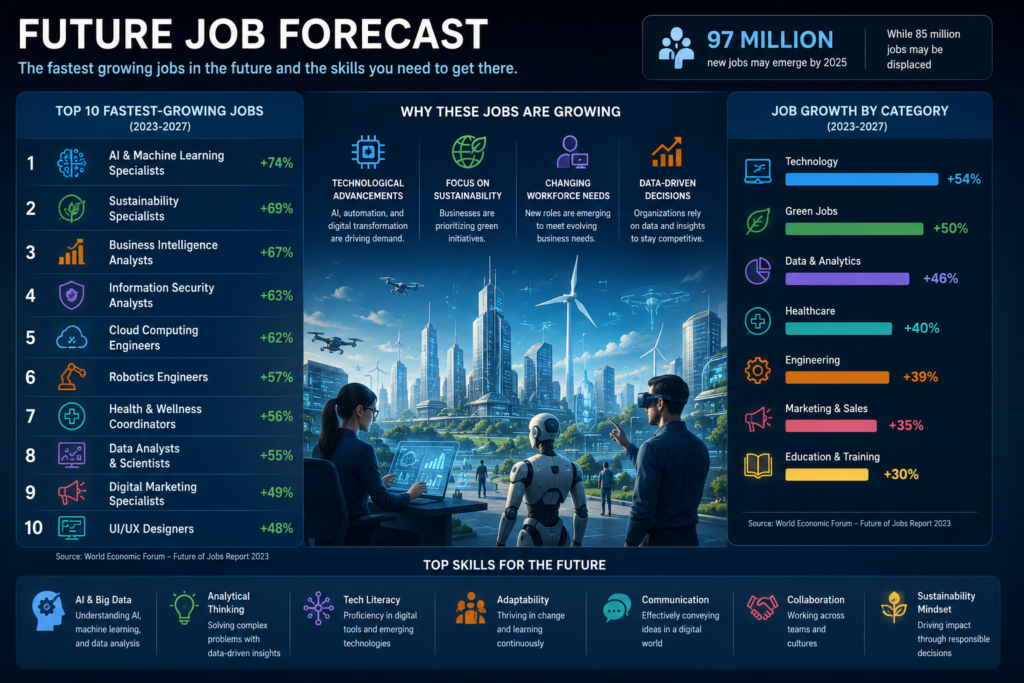
The following roles are projected by the BLS, WEF, McKinsey, and independent research to see the strongest growth over the next decade — driven by one or more of three mega-forces: the AI and data revolution, the green energy transition, and the global care and health demand from aging populations. These are not just high-growth roles — many combine growth with genuine scarcity of qualified talent, which means outsized salaries, rapid advancement, and exceptional job security.
01 · Technology
AI & Machine Learning Engineer
↑ Fastest growing globally
Designs, trains, and deploys machine learning models and AI systems that power everything from recommendation engines to autonomous systems. The WEF identifies AI specialists as the single fastest-growing role category by percentage through 2030.
$120,000 – $250,000+
Why: 86% of businesses are being transformed by AI — every sector needs engineers who can build and deploy it.
02 · Technology
Cybersecurity Analyst
↑ +29% growth by 2034
Monitors networks, investigates breaches, builds security frameworks, and protects organisations from cyberattacks. Cybercrime caused an estimated $10.5 trillion in damage globally in 2025, making this one of the most urgently needed roles on the planet.
$95,000 – $175,000
Why: Every company digitising is also becoming a target. The talent gap is severe — millions of unfilled roles worldwide.
03 · Data & Analytics
Data Scientist
↑ BLS top-tier growth
Extracts insight from complex datasets using Python, SQL, and machine learning. Identifies patterns, builds predictive models, and translates results into business decisions. One of the most intellectually demanding and financially rewarding roles in the modern economy.
$100,000 – $200,000
Why: Data is the oil of the 21st century — every organisation needs someone who can refine it into decisions.
04 · Healthcare
Nurse Practitioner & Advanced Care Provider
↑ +52% growth 2023–2033
Provides primary and specialised care, often independently prescribing treatments. As populations age globally and physician shortages deepen, NPs are filling a critical care gap — with one of the strongest projected growth rates of any profession in the BLS dataset.
$120,000 – $160,000
Why: AI augments healthcare — it doesn’t replace the human judgment and empathy at its core.
05 · Green Economy
Renewable Energy Engineer
↑ 34M new jobs by 2030
Designs and implements solar, wind, hydro, and bioenergy systems. The green transition is the single largest structural driver of new employment globally. Climate-change mitigation is expected to transform 47% of businesses by 2030 — creating massive demand for engineers who can build the infrastructure of the clean energy future.
$80,000 – $145,000
Why: 34 million additional farmworker and green-tech jobs projected by 2030 per WEF — the largest single sector growth.
06 · Finance & Tech
Fintech Engineer & Financial Data Analyst
↑ High-growth specialist role
Builds the digital rails of modern finance — payment systems, blockchain applications, algorithmic trading, and embedded finance products. The WEF lists fintech engineers among the fastest-growing roles globally as digital-first financial services displace traditional banking infrastructure.
$110,000 – $220,000
Why: Global fintech investment remains at record levels; every legacy bank is in urgent transformation mode.
07 · Life Sciences
Biotechnology & Genetic Engineer
↑ Strong decade-long growth
Works on gene therapies, personalised medicine, CRISPR applications, genetically modified crops, and bioproducts. As healthcare shifts from treatment to prevention, and as climate change demands agricultural innovation, biotech is emerging as one of the most future-proof and high-impact career domains of the next decade.
$85,000 – $165,000
Why: Post-pandemic investment in life sciences remains elevated — governments and private capital are both betting big on biotech.
08 · Infrastructure
Cloud Computing Engineer
↑ Software dev +17.9% by 2033
Designs, deploys, and manages cloud infrastructure — the backbone of virtually every digital service and AI application. As enterprises continue migrating to cloud-first architectures and AI workloads explode demand for compute, skilled cloud engineers remain among the most sought-after technology professionals globally.
$105,000 – $195,000
Why: Every AI model, every digital service, every enterprise system runs on cloud — the demand ceiling is still rising.
09 · Sustainability
ESG & Climate Risk Specialist
↑ Emerging priority role
Advises corporations on environmental, social, and governance strategy — measuring carbon footprints, managing climate risk disclosures, and navigating the rapidly expanding regulatory landscape around sustainability. As regulators globally mandate ESG reporting, demand is surging across financial services, consulting, and corporate strategy.
$90,000 – $160,000
Why: Climate-change adaptation is expected to transform 41% of businesses by 2030 — ESG expertise is now a boardroom priority.
10 · Human Services
Home Health Aide & Eldercare Professional
↑ +34% growth outlook
Assists elderly and disabled clients with daily living activities, health monitoring, and emotional support — often in private homes as populations age globally and “ageing in place” becomes the preferred care model. This is one of the largest-growing roles in absolute job numbers in the BLS projections.
$30,000 – $55,000
Why: Global populations are aging rapidly. No algorithm or robot can replicate the human empathy at the heart of care work.
The skills that will define the rising careers of 2035 fall into three distinct families:
AI fluency
Data literacy
Cloud architecture
Cybersecurity
Machine learning
Analytical thinking
Critical reasoning
Emotional intelligence
Leadership
Creativity
Climate science
Sustainability strategy
Renewable energy systems
“Advances in AI and renewable energy are reshaping the labour market — driving an increase in demand for technology or specialist roles while driving a decline for others. The time is now for businesses and governments to work together, invest in skills and build an equitable and resilient global workforce.”
— Till Leopold, Head of Work, Wages and Job Creation, World Economic Forum, January 2025↓ Least Demanding Jobs 2025–2035
The Careers the Future Is Phasing Out
The following roles face the most severe structural decline over the next decade. This is not about individual performance — it’s about structural automation. These are jobs where the core task involves repetitive data processing, routine rule-based decisions, or predictable physical operations that AI, robotic process automation (RPA), and machine learning can now perform faster, cheaper, and more accurately than humans. In many cases, the decline has already begun.
BLS & National University Research · 2025–2026
Clerical and administrative roles are among the first to be automated. Bank tellers are projected to decline 15% by 2033 (–51,400 jobs). Cashier employment is projected to fall 11% (–353,100 jobs). Entry-level white-collar job postings have already declined roughly 35% since January 2023, per Revelio Labs data.
01 · Administrative
Data Entry Clerk
↓ 7.5M positions at risk by 2027
Enters, verifies, and processes structured data from documents, forms, and systems into databases. This is perhaps the most directly AI-automatable role in existence — the entire job description is what AI does natively, at zero marginal cost, with zero errors.
Why declining: Intelligent document processing, OCR, and LLMs can perform this task more accurately and at a fraction of the cost.
02 · Finance
Bank Teller
↓ –15% by 2033 (–51,400 jobs)
Processes transactions — deposits, withdrawals, transfers, currency exchange — at bank branches. As digital banking, mobile payments, and ATM technology eliminate the need for in-person cash handling, branch networks are contracting globally at an accelerating pace.
Why declining: Digital-first banking. DBS Bank alone announced 4,000 role cuts over three years as AI replaces back and middle-office functions.
03 · Retail
Cashier & Checkout Operator
↓ –11% by 2033 (–353,100 jobs)
Processes retail purchases at checkout counters. Self-checkout kiosks, smartphone-based payment, and Amazon-style “just walk out” cashierless stores are rapidly replacing manual checkout roles. This is one of the largest absolute job-loss categories in the BLS projections.
Why declining: Self-checkout, AI-vision payment, and frictionless retail are already deployed at scale in major chains globally.
04 · Administrative
Executive Secretary & Administrative Assistant
↓ WEF fastest-declining list
Manages calendars, coordinates travel, handles correspondence, and provides administrative support to executives. AI-powered scheduling tools, email summarisers, and virtual assistants (like Copilot and Gemini) are already eliminating the cognitive load that defined this role.
Why declining: Generative AI has directly automated the primary tasks of this role — scheduling, drafting, summarising, and organising.
05 · Government/Logistics
Postal Service Clerk
↓ WEF fastest-declining list
Sorts, processes, and distributes mail and packages at postal facilities. The shift from physical to digital communication, combined with automated sorting and routing technology in logistics facilities, is reducing the need for manual postal roles at every level of the supply chain.
Why declining: Mail volumes continue to fall; logistics automation (robotic sorting, AI routing) displaces manual processing roles.
06 · Finance
Payroll Clerk & Bookkeeper
↓ WEF fastest-declining list
Processes employee payroll, manages accounts payable/receivable, and reconciles financial records. Cloud-based accounting platforms (Xero, QuickBooks, SAP) and AI-driven bookkeeping tools are automating the entire workflow, leaving fewer roles for manual financial record-keeping.
Why declining: Automated payroll software and AI accounting tools now perform this work end-to-end with minimal human input.
07 · Customer Service
Call Centre Agent (Routine)
↓ 80% automation potential
Handles inbound customer enquiries — account queries, billing issues, technical support — via phone or chat. AI chatbots, voice AI, and LLM-powered support systems now resolve the majority of routine customer queries without human involvement. High turnover in this role further accelerates its decline.
Why declining: AI can handle 80% of routine customer queries — and unlike human agents, doesn’t require breaks, training, or overtime pay.
08 · Creative (Generalist)
Graphic Designer (Entry-Level Generalist)
↓ Explicitly named by WEF
Creates visual assets — social media graphics, banners, templates, basic marketing materials — for clients and internal teams. Entry-level generalist graphic design has been directly disrupted by AI image generation tools (Midjourney, DALL-E, Adobe Firefly) that produce production-quality assets from text prompts in seconds.
Why declining: AI image tools have reduced demand for template-level design by 30–50% on freelance platforms since 2022. Specialist, strategic designers remain valuable.
09 · Travel & Leisure
Travel Agent
↓ Long structural decline
Books flights, hotels, and itineraries for leisure and business travellers. Online booking platforms (Booking.com, Expedia, Google Flights) have already displaced most of this role’s functions. AI travel planning tools now create complete, personalised multi-city itineraries in seconds — accelerating a decline that began with the internet.
Why declining: Consumers have self-served travel booking for two decades. AI takes the final remaining value-add — complex itinerary creation — and automates it too.
10 · Sales
Telemarketer
↓ Among highest automation risk
Makes outbound calls to prospective customers to sell products or services. Already among the least popular occupations globally, telemarketing is being replaced from two directions simultaneously: robocall AI that makes outbound calls autonomously, and tightening regulatory restrictions on unsolicited calling.
Why declining: AI can call, pitch, handle objections, and follow up at infinite scale — at a cost that makes human telemarketers economically unviable.
Side-by-Side: The 2035 Career Divide
Here’s a quick-reference comparison of growing and declining roles across sectors — sourced from BLS projections, the WEF Future of Jobs Report 2025, and McKinsey workforce research.
| Sector | Growing Role | Declining Role | Primary Force |
|---|
| Technology | AI/ML Engineer ↑ Fast | Entry-level programmer ↓ AI coding | AI automation |
| Finance | Fintech Engineer ↑ High demand | Bank Teller ↓ –15% | Digital banking |
| Healthcare | Nurse Practitioner ↑ +52% | Medical transcriptionist ↓ AI scribing | Aging population + AI |
| Retail | Supply chain analyst ↑ Growing | Cashier ↓ –353K jobs | Self-checkout & automation |
| Energy | Renewable Energy Engineer ↑ 34M new | Coal mining operative ↓ Structural | Green transition |
| Administration | People/Culture analyst ↑ Growing | Executive Secretary ↓ AI tools | Generative AI |
| Creative | AI prompt engineer / UX designer ↑ Growing | Generalist graphic designer ↓ AI image gen | AI image generation |
| Data | Data Scientist ↑ Top tier | Data Entry Clerk ↓ 7.5M at risk | AI document processing |
| Logistics | Delivery driver / logistics coordinator ↑ WEF top 15 | Postal service clerk ↓ WEF top decline | E-commerce vs. mail decline |
| Customer Service | Customer success manager ↑ Growing | Call centre agent (routine) ↓ 80% automatable | Conversational AI |
Your 2035 Survival Guide
How to Position Yourself for What’s Coming
The data is clear: the jobs of 2035 reward those who learn to work with AI, not those who ignore it. The most resilient careers combine technical fluency with irreducibly human capabilities — empathy, judgment, creativity, and leadership. Here are the four moves that matter most.
🧠
Build AI literacy now
You don’t need to become an ML engineer overnight. But understanding how to use, prompt, and collaborate with AI tools puts you ahead of 60% of the current workforce. Start with the tools in your existing role.
🌿
Lean into green skills
The green transition is creating 34 million new jobs by 2030. Climate finance, sustainability strategy, clean energy engineering, and ESG advisory are sectors with more demand than supply for the foreseeable future.
🤝
Double down on human skills
Eight of the top ten most in-demand future skills are classified as “durable human skills” — analytical thinking, creativity, emotional intelligence, leadership. These are the skills AI cannot replicate and employers are explicitly prioritising.
🔬
Go specialist, not generalist
AI eats generalist roles fastest. Specialists — in biotech, cybersecurity, climate science, advanced healthcare — see growing demand precisely because their expertise is narrow, deep, and hard to replicate. Niche is the new safe.
WEF Future of Jobs Report 2025 · Critical Warning
If the global workforce were represented by 100 people, 59 would need reskilling or upskilling by 2030 — and 11 of them are unlikely to receive it. This translates to over 120 million workers facing medium-term redundancy risk. The time to act is not 2029. It is now.
The Bottom Line: Pick Your Side of History
The great job reshuffle of 2025–2035 is not a crisis — it is the largest career opportunity in a generation, for those who read the map correctly. 170 million new jobs will be created. Roles in AI, data science, cybersecurity, renewable energy, advanced healthcare, and sustainability are not just growing — they are desperate for qualified talent.
But the exits are closing too. 92 million roles face displacement. Data entry, routine administration, generalist design, legacy customer service, and physical cash-handling — these are the jobs that will feel the force of automation hardest and fastest.
The defining skill of 2035 is not knowing how to code, or how to build a solar panel, or how to care for an aging patient. It is knowing which direction the tide is moving — and having the adaptability to swim with it, not against it.
Sources: WEF Future of Jobs Report 2025 · BLS Occupational Outlook Handbook · McKinsey Global Institute · Goldman Sachs AI Workforce Analysis · IMF · Coursera / BLS April 2025 salary data · National University AI Job Statistics Report 2026.