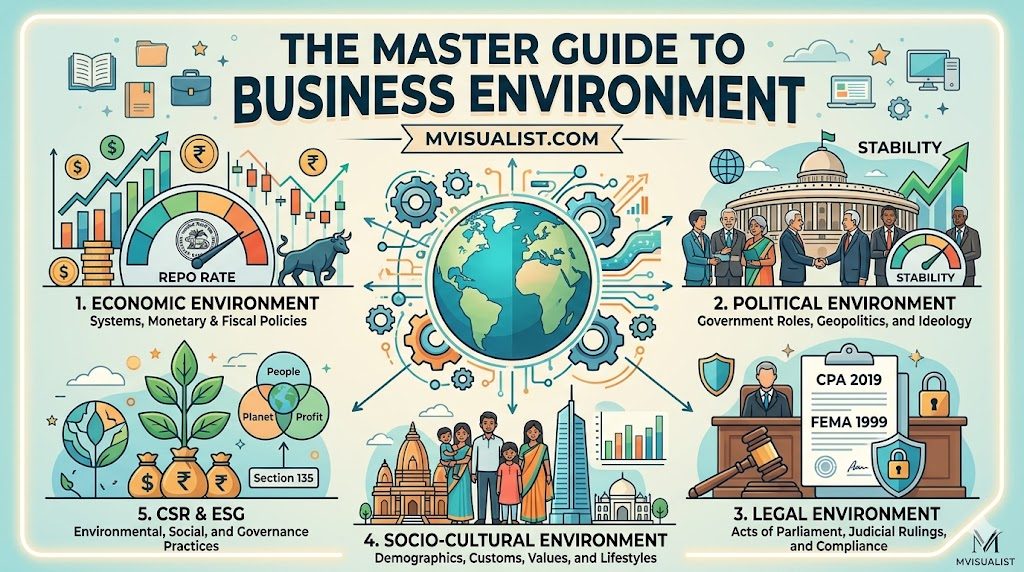
The Master Guide to Business Environment
Explore the Economic, Political, Legal, and Socio-Cultural forces that shape global commerce, complete with real-world case studies and a live AI analyzer.
The Economic Environment
The economic environment is the foundational bedrock upon which every commercial enterprise operates. It dictates the availability of capital, the purchasing power of consumers, the cost of raw materials, and the overall trajectory of business growth. A business strategy that ignores the macroeconomic climate is akin to sailing a ship without a compass in a storm. To master this concept, we must dissect it into its two primary, monumental pillars: Economic Systems and Macroeconomic Policies (Monetary and Fiscal).
1. Economic Systems: The Grand Rules of Commerce
An economic system defines the structural framework through which a society or nation allocates its scarce resources. It answers three fundamental questions: What should be produced? How should it be produced? And for whom should it be produced? The chosen system dictates the level of freedom an entrepreneur possesses, the intensity of market competition, and the extent of private property rights.
-
A. Capitalism (The Free Market Economy)
Championed by classical economists like Adam Smith, capitalism operates on the principle of laissez-faire—minimal government interference. In a pure capitalist system, all means of production (land, labor, capital) are owned by private entities. The “invisible hand” of market demand and supply dictates production volumes and pricing mechanisms. The primary, unapologetic motive of enterprise in this system is profit maximization.
In this environment, competition is fierce, driving innovation and efficiency. However, critics argue it can lead to wealth concentration and the formation of monopolies if left completely unchecked.
Real-Life Case Study: The United States Tech EcosystemThe U.S. economy is the world’s most prominent example of capitalism. The meteoric rise of Silicon Valley giants—Apple, Google, Microsoft, and Tesla—was made possible by a system that aggressively rewards private innovation, allows massive accumulation of private venture capital without state limits, and permits companies to dictate their product pricing freely based entirely on consumer demand and perceived brand value. If a consumer is willing to pay $1,500 for a smartphone, the capitalist market obliges without government price caps.
-
B. Socialism (The Command Economy)
At the opposite end of the spectrum is socialism, rooted in Marxist theory. Here, the state (or the collective society) owns the major means of production. Central planners—not the free market—dictate production quotas, resource allocation, and consumer prices. The overriding objective is social welfare, equitable distribution of wealth, and the theoretical elimination of class divides.
In a strict command economy, private entrepreneurship is either banned or heavily heavily regulated. While it guarantees basic necessities to all citizens, it historically suffers from massive inefficiencies, lack of innovation (as the profit motive is removed), and bureaucratic bottlenecks.
Real-Life Case Study: Cuba and the Early USSRIn the historical Soviet Union, the Gosplan (State Planning Committee) dictated the production of everything from military tanks to civilian shoes. This often led to massive shortages of consumer goods because central planners could not accurately predict complex human demand. Today, Cuba still operates primarily under a socialist framework where the state controls most major industries, heavily restricting private wealth accumulation and foreign business operations, leading to a largely stagnant consumer market.
-
C. The Mixed Economy
Recognizing the flaws in both extremes, most modern nations operate a mixed economy. This system blends the innovation and efficiency of free-market capitalism with the social welfare and regulatory oversight of socialism. Critical industries involving national security, massive infrastructure, or basic public welfare (like defense, railways, or primary healthcare) may be state-controlled or heavily subsidized, while other sectors (FMCG, IT, retail) are left to fierce private competition.
Real-Life Case Study: India’s Economic EvolutionIndia is the quintessential mixed economy. Pre-1991, India leaned heavily socialist under the “License Raj,” where private companies needed government approval to increase production output. Post the 1991 Liberalization, Privatization, and Globalization (LPG) reforms, the economy was unchained. Today, we witness private behemoths like Reliance Industries and the Tata Group competing aggressively on a global scale, while the Indian government simultaneously operates massive Public Sector Undertakings (PSUs) like the Indian Railways and Life Insurance Corporation (LIC) to ensure widespread public service.
2. Macroeconomic Policies: The Levers of Control
Even within a free or mixed market, the macroeconomic environment is continuously manipulated by authorities to maintain stability, control inflation, and stimulate growth. Businesses must constantly monitor these two vital policies to adjust their capital expenditure and pricing strategies.
Monetary Policy
Formulated and executed by a nation’s Central Bank (such as the Reserve Bank of India – RBI, or the Federal Reserve in the US), monetary policy regulates the total money supply in the economy and the cost of borrowing (interest rates). Its primary goals are price stability (inflation control) and facilitating economic growth.
Key Instruments of Monetary Policy:
- Repo Rate: The rate at which the central bank lends money to commercial banks. A high Repo Rate makes borrowing expensive, slowing down the economy to curb inflation. A low Repo Rate makes loans cheaper, stimulating business expansion and consumer spending.
- Cash Reserve Ratio (CRR): The percentage of total deposits that commercial banks must keep in liquid cash with the central bank. Increasing CRR sucks liquidity out of the market.
- Open Market Operations (OMO): The buying and selling of government securities in the open market to regulate the money supply.
Following the post-pandemic supply chain disruptions and geopolitical conflicts, global inflation skyrocketed. In response, central banks worldwide aggressively tightened monetary policy. The RBI consecutively raised the Repo Rate.
The Business Result: Commercial banks immediately raised loan interest rates. EMIs for home and auto loans surged, leaving consumers with less disposable income. Simultaneously, the “cost of capital” for businesses increased dramatically. Highly leveraged sectors, particularly the tech startup ecosystem, faced a severe “funding winter.” Venture capitalists stopped writing blank checks because risk-free interest rates were suddenly attractive, forcing thousands of startups into massive layoffs and extreme cost-cutting to survive.
Fiscal Policy
Formulated by the Executive Government (usually presented via the Ministry of Finance during the Annual Union Budget), fiscal policy deals directly with government revenue (taxation) and government expenditure (public spending, subsidies, infrastructure). It is the government’s direct lever to stimulate economic activity or bridge fiscal deficits.
Key Instruments of Fiscal Policy:
- Direct & Indirect Taxation: Adjusting Corporate Tax, Income Tax, and GST rates. Lower taxes mean higher corporate retained earnings and higher consumer purchasing power.
- Capital Expenditure (Capex): Government spending on massive infrastructure projects like highways, ports, and railways.
- Subsidies and Welfare: Transfer payments to the lower-income demographic, which immediately translates into consumption demand for FMCG and basic goods.
In a historic fiscal move in late 2019, the Government of India slashed the base corporate tax rate from 30% to 22% for existing domestic companies, and to a highly competitive 15% for new manufacturing firms to compete with Southeast Asia.
The Business Result: This massive fiscal stimulus immediately boosted the net profit margins of listed Indian companies, creating a stock market rally. Companies utilized the extra capital to deleverage (pay off debts) or reinvest in capacity expansion. Furthermore, recent Union Budgets have seen unprecedented increases in Capital Expenditure (Capex) allocation for infrastructure. This fiscal spending creates massive, guaranteed order books for businesses in cement, steel, heavy engineering (like L&T), and logistics, driving a multiplier effect of job creation across the economy.
The Political Environment
A business might possess a flawless economic model and unlimited capital, but an adverse shift in the political environment can render it entirely obsolete overnight. The political environment encompasses the stability of the ruling government, its political ideology, its foreign policy, and the overarching attitude of politicians and bureaucrats toward private enterprise. Political stability is the absolute, non-negotiable prerequisite for long-term domestic and foreign capital investment. Capital is a coward; it flees from political chaos.
The Multi-Faceted Role of Government in Business
Gone are the days when the state was merely a night-watchman responsible only for law and order. In the modern global economy, the government plays a deeply entrenched, multi-dimensional role in shaping the business landscape. We can categorize this involvement into four distinct roles:
1. The Regulatory Role
To prevent capitalist systems from descending into exploitative monopolies and chaos, the government acts as a strict referee. It establishes independent regulatory bodies to ensure fair play, protect consumers, and maintain market integrity. For example, the Securities and Exchange Board of India (SEBI) regulates the stock markets to prevent insider trading. The Competition Commission of India (CCI) ensures that giant corporations do not use predatory pricing to kill small competitors. Environmental agencies strictly regulate industrial emissions. Businesses must weave these massive regulatory compliance costs into their operational budgets.
2. The Promotional Role
Here, the government acts as a cheerleader and enabler for private enterprise to achieve strategic national goals (like boosting exports or self-reliance). Governments offer massive tax holidays, subsidized land, cheap electricity, and establish Special Economic Zones (SEZs). They provide export credit guarantees and fund national startup incubators. This promotional role actively lowers the barriers to entry and operational costs for businesses willing to align with the government’s political-economic agenda.
3. The Entrepreneurial Role
Sometimes, the private sector lacks the immense capital, risk appetite, or technological capability to build core strategic infrastructure. In such cases, the government steps in as a direct business operator. Historically, this meant building massive steel plants, heavy machinery factories, and telecom networks. Today, it is most visible in strategic sectors like atomic energy, space exploration (ISRO’s commercial arm NewSpace India Limited), and mass subsidized transport (Indian Railways).
4. The Planning Role
Governments act as macro-architects. Through bodies like the NITI Aayog in India, the political leadership maps out long-term strategic visions (e.g., transition to Electric Vehicles by 2030, or semiconductor manufacturing hubs). They assess national resources, define priority sectors, and align state policies to ensure the entire economic machinery moves cohesively toward a defined political-economic target. Private businesses closely watch these plans to pivot their future investments.
Deep Dive Case Studies: Political Impact in Action
The global business environment was fundamentally fractured when shifting political ideologies and national security concerns led the United States to initiate a massive trade and technology war against China. The US government imposed sweeping tariffs and legally blacklisted Chinese telecom giant Huawei, crippling its global smartphone and 5G infrastructure business overnight. Furthermore, the political establishment implemented severe export controls on advanced semiconductors, legally preventing companies like Nvidia and ASML from selling high-end AI chips and manufacturing equipment to China.
Business Implication: This political move forced global tech giants into a frantic “China Plus One” strategy. Companies like Apple and Samsung, driven by political risk rather than pure economic efficiency, began moving billions of dollars in manufacturing lines to politically friendly nations like India and Vietnam to de-risk their supply chains.
Determined to transform India into a global manufacturing hub and reduce reliance on massive electronic imports, the Indian political establishment launched the Production Linked Incentive (PLI) scheme. This is a masterful execution of the government’s promotional role. The government pledged billions of dollars in direct financial incentives to companies based on their incremental sales of goods manufactured in India.
Business Implication: This political policy drastically altered the economic mathematics of manufacturing. Enticed by the subsidies, global contract manufacturers for Apple (Foxconn, Wistron, Pegatron) set up massive mega-factories in Tamil Nadu and Karnataka. Domestic companies like Dixon Technologies saw unprecedented growth. A purely political initiative successfully birthed a robust electronics manufacturing ecosystem within half a decade.
The Legal Environment
While the political environment outlines the intent and vision of a nation, the legal environment constitutes the rigid, enforceable framework within which every business must strictly operate. It comprises Acts of Parliament, constitutional provisions, judicial rulings, and stringent compliance mandates. Ignorance of the law is never an acceptable defense in corporate litigation. A robust legal environment guarantees contract enforcement, intellectual property protection, and consumer rights. In this masterclass, we will meticulously analyze two revolutionary legal frameworks that have reshaped Indian business operations: The Consumer Protection Act, 2019 and FEMA, 1999.
1. Consumer Protection Act (CPA), 2019: The Era of Caveat Venditor
For decades, Indian businesses operated under the CPA of 1986, which was fundamentally ill-equipped to handle the complexities of the modern digital economy, e-commerce, and aggressive digital marketing. The enactment of the CPA 2019 was a paradigm shift. It officially transitioned the legal doctrine of the market from Caveat Emptor (Let the buyer beware) to Caveat Venditor (Let the seller beware). Businesses are now under unprecedented legal scrutiny regarding product quality, advertising claims, and data fairness.
Revolutionary Provisions of CPA 2019:
- Establishment of CCPA (Central Consumer Protection Authority)
Unlike the past where a consumer had to initiate a long legal battle, the CCPA operates like a proactive regulatory watchdog. It possesses immense power to initiate suo-motu actions (acting on its own without a formal complaint), file class-action lawsuits on behalf of millions of affected consumers, order the immediate recall of unsafe goods, and impose crippling penalties for false advertising.
- Strict Product Liability
Previously, proving negligence for an exploding battery or a toxic food item was extremely difficult. The new act introduces the concept of strict Product Liability. Manufacturers, service providers, and critically, even product sellers (including massive e-commerce marketplaces) are now strictly legally liable to compensate a consumer for harm, injury, or death caused by a defective product or deficient service.
- E-Commerce and ‘Dark Patterns’ Regulation
The act legally binds e-commerce platforms to maintain absolute transparency. They must display the “Country of Origin” for all products (a critical requirement post geopolitical tensions), provide transparent return/refund rules within stipulated hours, and are strictly prohibited from manipulating search algorithms to favor their own in-house brands. Recently, the government issued stringent legal guidelines against “Dark Patterns”—deceptive UI/UX designs used by websites (like tricking users into adding insurance to flight tickets or making unsubscribing incredibly difficult).
Under the CPA 2019, celebrity endorsers and social media influencers can no longer hide behind ignorance. If an influencer promotes a product making false claims (e.g., a “miracle” weight-loss pill or a high-risk crypto scheme as a guaranteed return), the CCPA can hold the endorser personally liable.
They face fines extending up to ₹50 Lakhs and can be legally barred from endorsing any product for up to 3 years. Recently, numerous Ed-Tech platforms and FMCG companies faced severe legal notices from the CCPA for claiming “100% success rates” or “immunity-boosting” properties without rigorous scientific backing. This has forced marketing agencies to drastically alter how campaigns are legally vetted before release.
2. FEMA (Foreign Exchange Management Act, 1999)
In the pre-liberalization era, India suffered from a severe shortage of foreign reserves and operated under FERA (Foreign Exchange Regulation Act, 1973). FERA was a draconian law that treated any violation of foreign exchange rules as a severe criminal offense, leading to immediate arrests. It stifled international trade and terrified foreign investors. With the advent of globalization and a booming IT/Export sector, the legal environment desperately needed to shift from aggressively “regulating” and restricting foreign exchange to efficiently “managing” it. Thus, the Parliament enacted FEMA in 1999, making offenses civil rather than criminal.
FEMA’s primary objective is to legally facilitate external trade, smooth out international payments, and promote the orderly development of the foreign exchange market in India. It acts as the gatekeeper for all inward and outward flow of foreign currency. FEMA neatly categorizes all international financial transactions into two distinct buckets:
1. Current Account Transactions
These relate to day-to-day international trade activities that do not alter the assets or liabilities of a person/entity abroad. This includes the regular import and export of physical goods, paying for software subscriptions, remittances for living expenses of children studying abroad, or travel expenses.
FEMA Rule: As a rule of thumb, under FEMA, current account transactions are generally fully convertible and free from RBI restrictions, unless explicitly prohibited by the government (such as remitting money out of India for buying lottery tickets or gambling).
2. Capital Account Transactions
These are massive, structural transactions that alter the assets or liabilities of an Indian resident abroad, or a non-resident in India. Examples include an Indian IT giant acquiring a software firm in the US, an American Venture Capital firm investing $100 Million in an Indian startup, or foreign entities buying land in India.
FEMA Rule: Because these transactions can cause massive volatility in exchange rates and impact national security, they are strictly regulated by the Reserve Bank of India (RBI). They are often subject to sectoral caps under the Foreign Direct Investment (FDI) policy.
When the US retail titan Walmart moved to acquire a 77% controlling stake in Indian e-commerce decacorn Flipkart for a staggering $16 billion in 2018, the entire structure of the mega-deal was dictated by the legal constraints of FEMA and India’s FDI policies.
India’s FDI laws (enforced under FEMA regulations) strictly prohibit foreign companies from operating “inventory-based” e-commerce models (where the platform owns the goods it sells) to protect millions of small Indian retail shopkeepers (kiranas) from being wiped out by deep-discounting foreign giants. Therefore, Walmart could only legally execute the acquisition if Flipkart operated purely as a “marketplace model”—a technology platform that merely connects third-party independent Indian sellers with Indian buyers, taking a commission, rather than holding and selling its own inventory directly. This legal environment forced Walmart to accept a highly restricted operational model compared to its US operations.
The Socio-Cultural Environment
A business is fundamentally a sub-system of the larger human society. It does not operate in a sterile vacuum; it takes inputs (labor, capital, raw materials) from the community and supplies outputs (goods, services, and employment) back into it. Consequently, attempting to force a product into a market while remaining blind to its socio-cultural fabric is a guaranteed recipe for corporate disaster. This environment is an intricate tapestry of Demographics, Customs, Religious Sentiments, Societal Values, Evolving Lifestyles, and Ethical Beliefs.
Key Drivers of the Socio-Cultural Environment
1. The Power of Demographics
Demographics represent the statistical characteristics of a population (age, income, education, gender ratio). A nation’s demographic profile entirely dictates its macro-demand. For example, Japan and many Western European countries are facing rapid population aging. Their business environments are experiencing massive booms in geriatric healthcare, automated robotics for elder assistance, and pharmaceuticals. Conversely, India boasts a massive “demographic dividend” with one of the youngest populations globally (median age around 28). This youthful demographic dictates an explosive, multi-billion dollar market skewed heavily toward Ed-Tech, affordable fast fashion, gaming, two-wheelers, digital entertainment, and first-time housing.
2. Cultural Traditions & Beliefs
Deep-rooted festivals, religious sentiments, and historical customs directly shape seasonal consumer behavior. In India, the festive period spanning Navratri, Dussehra, and Diwali sees an unparalleled, explosive spike in the retail sales of gold jewelry, automobiles, consumer electronics, and real estate. This is driven not just by discounts, but by the profound socio-cultural belief that purchasing assets during these auspicious times brings long-term prosperity. Businesses structure their entire annual supply chain, marketing budgets, and inventory around this cultural phenomenon.
3. Evolving Lifestyles, Values, and “Cancel Culture”
Societal shifts possess the destructive and creative power to birth new industries while rendering old ones bankrupt. Over the last decade, a massive global consciousness has arisen regarding personal health, climate change, and animal cruelty. This socio-cultural shift has birthed multi-billion-dollar industries in alternative meat (e.g., Beyond Meat), organic agriculture, electric vehicles, and sustainable, ethical fashion.
Furthermore, the modern consumer is highly vocal and hyper-connected. If a business’s advertising or corporate values clash with shifting societal values regarding race, gender equality, or environmentalism, it faces immediate boycotts—widely known as “cancel culture.” For instance, responding to socio-cultural pressure regarding colorism and unrealistic beauty standards, consumer goods giant Unilever was compelled to fundamentally rebrand its flagship cream from “Fair & Lovely” to “Glow & Lovely”.
Real-Life Masterclass: McDonald’s & Kellogg’s in India
When the American fast-food behemoth McDonald’s entered the Indian market in the mid-1990s, they confronted a seemingly insurmountable socio-cultural hurdle: a vast majority of the population did not consume beef (due to Hindu reverence for cows) or pork (due to Islamic dietary laws). Launching their global flagship, the beef-based Big Mac, would have been a catastrophic, offensive failure.
Displaying immense respect for the socio-cultural environment, McDonald’s executed one of the greatest localizations in corporate history. They completely reinvented their supply chain and menu. The Big Mac was replaced by the chicken-based Maharaja Mac. They created an extensive, highly successful vegetarian menu (like the McAloo Tikki) and established completely segregated vegetarian and non-vegetarian cooking areas in their kitchens to respect religious purities. This deep cultural integration led to massive market dominance.
Conversely, when Kellogg’s introduced cold breakfast cereal to India, they arrogantly assumed consumers would rapidly abandon centuries-old traditional hot breakfasts (like steaming parathas, idli, upma, or poha). Moreover, they failed to understand a crucial cultural nuance: Indians traditionally boiled their milk to ensure it was safe, and consumed it hot and heavily sweetened. When consumers poured hot milk over Kellogg’s crispy cornflakes, they instantly turned into a soggy, unappetizing mush. The product fundamentally clashed with the socio-cultural eating habits of the demographic. Kellogg’s struggled for years, bleeding capital, before eventually realizing they had to pivot their messaging and product lines to adapt to Indian palettes.
Corporate Social Responsibility (CSR)
Corporate Social Responsibility (CSR) represents a fundamental shift in how corporate success is measured. It is the profound integration of Environmental, Social, and Governance (ESG) practices into a company’s core business model. True CSR goes far beyond ad-hoc philanthropy or public relations stunts. It acknowledges a powerful truth: businesses draw immense natural resources, labor, and infrastructural benefits from society. Therefore, they hold an inescapable moral—and increasingly, strict legal—obligation to replenish, sustain, and elevate that society.
Modern corporate governance operates on the paradigm of the Triple Bottom Line: People, Planet, and Profit. In the 21st century, financial viability (profit) is no longer the sole metric of a company’s worth. Institutional investors, sovereign wealth funds, and highly conscious consumers relentlessly scrutinize a corporation’s ecological footprint (planet) and its impact on community welfare and labor rights (people). Companies that ignore CSR face immense reputational risks, capital flight, and regulatory crackdowns.
The Groundbreaking Legal Mandate: Section 135 (Companies Act, 2013)
While CSR was historically viewed as a voluntary, ethical best practice in Western economies, India created global legal history by becoming the first country to statutorily mandate CSR spending for large corporations. Under Section 135 of the Companies Act, 2013, the government transformed CSR from a “nice-to-have” charity into a strict, legally binding compliance requirement.
The Applicability Criteria:
The mandate applies to any company (public or private, domestic or foreign subsidiary) operating in India that meets any one of the following financial thresholds in the immediately preceding financial year:
- A Net Worth of ₹500 Crore or more.
- A Turnover of ₹1,000 Crore or more.
- A Net Profit of ₹5 Crore or more.
The Core Mandate (The 2% Rule):
Qualifying companies are legally obligated to constitute a formal CSR Committee at the Board level. They must spend, in every financial year, at least 2% of their average net profits generated over the three immediately preceding financial years on sanctioned CSR activities.
These activities are strictly defined under Schedule VII of the Act, encompassing eradication of extreme hunger and poverty, promotion of education and gender equality, ensuring environmental sustainability, rural development projects, and contributions to the Prime Minister’s National Relief Fund. Failure to spend or report this amount attracts heavy financial penalties and severe regulatory scrutiny.
Real-Life Case Studies: Exceptional CSR in Action
Long before CSR became an international buzzword or a legal mandate, the Tata Group embedded profound societal welfare into its corporate DNA. Founder Jamsetji Tata famously declared that in a free enterprise, the community is not just another stakeholder, but in fact, the very purpose of its existence.
In a unique corporate structure, Tata Trusts (a philanthropic organization) holds a massive 66% equity stake in Tata Sons (the holding company of the entire Tata conglomerate). This structure ensures that the majority of the colossal profits generated by companies like TCS, Tata Motors, and Tata Steel flow directly back into charitable trusts. These funds have historically established and continuously fund premier national institutions like the Tata Memorial Hospital (leading cancer research) and the Tata Institute of Social Sciences (TISS). The Tata model proves that massive profitability and profound societal upliftment are not mutually exclusive.
ITC Limited, a major Indian conglomerate, pioneered a brilliant concept known as “Creating Shared Value” (CSV) through its e-Choupal network. Rather than just giving away money, ITC integrated social upliftment directly into its core supply chain.
They placed computers with internet access (e-Choupals) in thousands of remote, rural farming villages across India, run by local farmers (Sanchalaks). This technology empowered historically exploited farmers to check real-time global agricultural crop prices, access accurate weather forecasts, and learn modern farming techniques. The farmers could then bypass exploitative local middlemen and sell their produce directly to ITC at fair, transparent prices. This initiative profoundly uplifted the rural socio-economic environment (fulfilling CSR objectives) while simultaneously securing a highly efficient, high-quality agricultural supply chain for ITC’s massive FMCG business.
✨ AI Industry Environment Analyzer
Curious how these concepts apply to a specific sector? Enter an industry below, and our embedded Gemini AI will instantly generate a custom analysis of its Economic, Political, and Legal landscape in India.
Empowering entrepreneurs through deep business analysis.