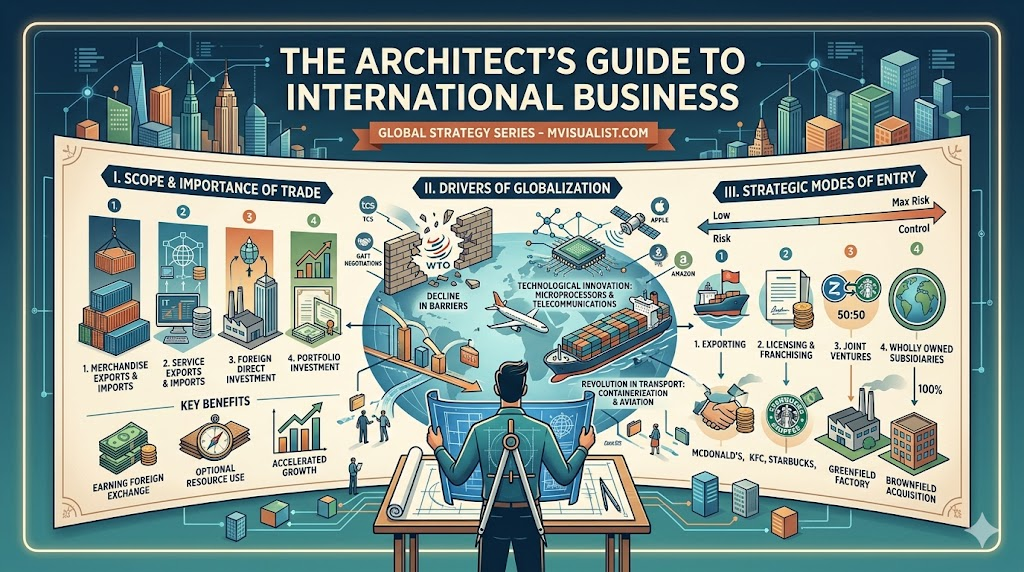
The Architect’s Guide to International Business
A definitive masterclass on the scope of global trade, the unstoppable drivers of globalization, and the strategic modes of entry into foreign markets.
Scope & Importance of International Business
International business extends far beyond the simplistic exchange of physical goods across borders. In the modern economic paradigm, it encompasses all commercial activities—sales, investments, transportation, and intellectual property transfers—that take place between two or more regions, countries, or nations beyond their political boundaries. As domestic markets reach saturation and global supply chains become inextricably linked, understanding the vast scope and critical importance of international business is no longer an option for modern corporations; it is a fundamental prerequisite for survival.
The Multi-Dimensional Scope
The scope of international business is incredibly vast, structurally categorizing the myriad ways capital, goods, and human intellect flow globally. We can divide this scope into four primary pillars:
- 1. Merchandise Exports & Imports
This is the most traditional, visible, and tangible aspect of international trade. It involves sending physical goods (like automobiles, pharmaceuticals, textiles, and machinery) out of a country (exports) or bringing them in (imports). This forms the core of a nation’s Balance of Trade.
- 2. Service Exports & Imports (Invisible Trade)
Unlike physical goods, this involves the cross-border exchange of intangible services. This includes tourism and travel, international logistics and shipping, global banking and financial services, and crucially, Information Technology (IT) and Business Process Outsourcing (BPO) services.
- 3. Foreign Direct Investment (FDI)
This is a massive pillar of global business. FDI occurs when a company heavily invests capital directly into facilities to produce or market a product in a foreign country. Unlike trading, FDI grants the investor direct operational control over the foreign entity. It involves building factories (Greenfield) or acquiring foreign companies (Brownfield).
- 4. Portfolio Investment
Unlike FDI, Foreign Portfolio Investment (FPI) does not seek managerial control. It involves purchasing financial assets—like stocks, bonds, or mutual funds—in a foreign country strictly for financial returns. It is highly liquid and often moves rapidly across borders chasing high interest rates or booming stock markets.
The Strategic Importance of International Business
Why do companies undertake the immense risks of political instability, currency fluctuations, and cultural misunderstandings to go global? The importance of international business can be viewed from both a macro (national) and micro (firm) level.
Importance to the Nation
- Earning Foreign Exchange: Exporting brings in precious foreign currency (like USD or Euros), which a nation desperately needs to pay for vital imports like crude oil, defense equipment, and advanced technology.
- Optimum Utilization of Resources: Nations are endowed unequally. International business allows a country to aggressively produce what it is best at (comparative advantage) and export the surplus, while importing what it cannot produce efficiently.
- Accelerated Economic Growth: FDI brings in massive capital, technological transfers, and infrastructure development, rapidly creating millions of jobs and lifting domestic living standards.
Importance to the Firm
- Growth When Domestic Markets Saturate: When a company has maximized its market share in its home country, international expansion is the only avenue for continued high-percentage revenue growth.
- Spreading Business Risks: Operating in a single country is highly risky. An economic recession, political crisis, or regulatory crackdown at home can bankrupt a domestic firm. Geographic diversification heavily mitigates this risk.
- Economies of Scale: Accessing global markets allows a company to dramatically scale up production volumes, lowering the per-unit cost of manufacturing and thereby destroying local competitors on price.
TCS (Services Scope): TCS perfectly illustrates the immense importance of service exports. Indian domestic demand for heavy IT services in the 1990s was minimal. TCS looked outward to the US and European markets. Today, TCS generates billions in foreign exchange for India by managing the core IT infrastructure for massive global banks, airlines, and retailers, proving that crossing borders is vital for exponential growth.
Apple Inc. (Risk Spreading & Resource Utilization): Apple does not manufacture its iPhones in California. Recognizing its comparative advantage in design and software, Apple delegates its manufacturing entirely to global supply chains (primarily in Asia). Furthermore, when smartphone sales plateaued in the US and Europe, Apple aggressively targeted massive emerging markets like China and India, utilizing international business to maintain its trillion-dollar valuation despite domestic saturation.
Globalization and its Drivers
Globalization refers to the profound shift toward a more integrated and interdependent world economy. Historically, national economies were isolated from each other by formidable barriers to cross-border trade, immense distances, time zones, language, and heavily conflicting government regulations. Globalization is the systematic dismantling of these barriers. It has two main facets: the Globalization of Markets (the merging of historically distinct national markets into one huge global marketplace) and the Globalization of Production (the sourcing of goods and services from locations around the globe to take advantage of national differences in cost and quality).
The Unstoppable Drivers of Globalization
The hyper-globalization we witness today did not happen by accident. It is propelled by powerful macro-environmental forces, primarily falling into political/regulatory shifts and massive technological innovations.
The Decline in Trade and Investment Barriers (Political Driver)
During the 1920s and 30s, nation-states erected formidable barriers to international trade in the form of massive tariffs (taxes on imports) to protect domestic industries. This heavily contributed to the Great Depression. Post World War II, advanced nations recognized the catastrophic nature of protectionism. Under the umbrella of the General Agreement on Tariffs and Trade (GATT), which later evolved into the World Trade Organization (WTO), countries systematically negotiated massive reductions in tariffs and quotas. Furthermore, countries aggressively dismantled barriers to Foreign Direct Investment (FDI), changing their laws to actively welcome foreign capital rather than fear it.
Technological Innovation: Microprocessors and Telecommunications
The lowering of trade barriers made globalization theoretical; technology made it an operational reality. The creation of the microprocessor enabled high-power, low-cost computing, vastly increasing the amount of information that can be processed. The explosion of satellite, optical fiber, and wireless telecommunication completely revolutionized global communications. The Internet exploded from a localized military tool into the backbone of global commerce. A software manager in Silicon Valley can now seamlessly coordinate with a coding team in Bangalore in real-time at near-zero cost, making the Globalization of Services entirely possible.
Revolution in Transportation Technology
The most underrated driver of globalization is Containerization. Before the invention of the standard shipping container, loading and unloading ships was a brutally slow, highly expensive, labor-intensive process. Containerization massively simplified transshipment from one mode of transport (trucks) to another (ships, trains). It fundamentally crashed the cost of shipping goods globally. Simultaneously, the advent of commercial jet aircraft shrank the world in terms of travel time, allowing corporate executives to oversee global empires efficiently.
Amazon represents the absolute pinnacle of globalization drivers converging. Through its highly advanced technological infrastructure (AWS) and deep integration with global shipping logistics networks (enabled by containerization and global aviation), Amazon coordinates a supply chain spanning thousands of independent factories across China, Vietnam, and India.
Furthermore, globalization has driven Consumer Convergence—where consumer tastes globally are converging on a global norm. A teenager in Tokyo, a student in Mumbai, and a professional in New York are all ordering the exact same standardized products (Nike sneakers, Levi’s jeans, Apple AirPods) via Amazon, illustrating how globalization of markets operates practically on the ground.
Modes of Entry into International Business
Once a firm decides to expand internationally, it faces a highly complex strategic decision: How exactly should it enter the foreign market? There is no single “correct” mode of entry. The choice fundamentally revolves around balancing the level of financial risk the firm is willing to take against the degree of managerial control it wishes to exercise over foreign operations.
The Strategic Spectrum of Entry Modes
1. Exporting
Exporting involves manufacturing the product in the home country and shipping it to the host country for sale. It is the most traditional and simplest entry mode.
- Pros: Avoids the massive costs of establishing manufacturing operations abroad. Helps realize experience curve and location economies.
- Cons: High transport costs, crippling tariff barriers, and reliance on local marketing agents who may lack loyalty.
2. Licensing & Franchising
Licensing: A licensor grants the rights to intangible property (patents, formulas, trademarks) to a foreign licensee for a specified period in return for a royalty fee (common in manufacturing).
Franchising: Similar to licensing, but usually applied to services. The franchisor sells intangible property but strictly insists the franchisee abide by rigid rules regarding business execution.
- Pros: Rapid global expansion with almost zero capital investment from the parent company.
- Cons: Risk of technological theft (licensee becoming a future competitor) and severe challenges in maintaining global quality standards.
3. Joint Ventures (JV)
A Joint Venture entails establishing a brand new firm that is jointly owned by two or more otherwise independent firms. Usually, it is a 50/50 partnership between a foreign entity and a local firm.
- Pros: Foreign firm immediately gains access to the local partner’s knowledge of the host country’s competitive conditions, culture, and political systems. It vastly reduces political risk (governments favor JVs).
- Cons: Massive conflicts and battles for control can erupt between partners if strategic goals diverge. Sharing of proprietary technology is risky.
4. Wholly Owned Subsidiaries
In a Wholly Owned Subsidiary (WOS), the foreign firm owns 100% of the stock. It can be done in two ways: setting up a completely new operation from scratch (a Greenfield Investment) or aggressively acquiring an established firm in the host nation (a Brownfield/Acquisition Investment).
- Pros: Absolute, draconian control over global strategic planning, operations, and zero risk of losing control over core technological competencies.
- Cons: It is the most costly and punishing method of serving a foreign market. The firm bears the full brunt of immense capital costs and operational risks.
Empowering global entrepreneurs with deep strategic insights.