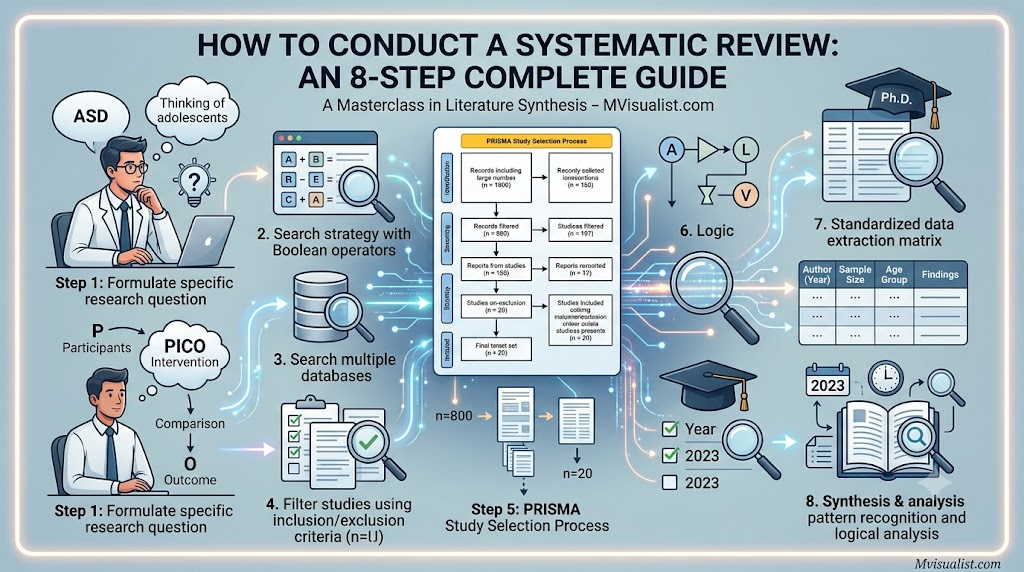
How to Conduct a Systematic Review: An 8-Step Complete Guide
A systematic review follows a clear and strict process. Master the art of academic literature synthesis from formulating the research question to final PRISMA documentation.
Conducting a systematic review is the gold standard for synthesizing existing literature. Unlike a narrative review, a systematic review requires a highly structured, replicable, and transparent methodology to eliminate bias. Below is a comprehensive, 8-step breakdown of how to execute a flawless systematic review, utilizing a real-world example regarding Autism Spectrum Disorder (ASD).
1 Research Question
What do I want to know? It is the absolute foundation of the entire review. Without a highly specific, answerable research question, your search strategy will fail.
Practical Example:
“How does Autism Spectrum Disorder (ASD) affect self-concept among adolescents?”
2 Keywords / Search Strategy
How will I search for studies? You must identify the main concepts from your research question and all their possible synonyms.
To combine these synonyms effectively, researchers use Boolean operators: AND, OR, NOT.
Search String Example:
("Autism" OR "ASD" OR "Autism Spectrum Disorder") AND ("Self-Concept" OR "Self-Perception") AND (Adolescent* OR Teenager* OR Youth)
3 Databases
Where will I search? You must search in more than one database to find the maximum number of relevant studies and avoid publication bias.
- Google Scholar
- PubMed
- PsycINFO
- Scopus
- Web of Science
4 Inclusion & Exclusion Criteria
Establish strict parameters before screening to ensure consistency. You must decide exactly what makes a study eligible or ineligible.
| Include (✓) | Exclude (✗) |
|---|---|
| ✓ Peer-reviewed articles | ✗ Editorials, letters |
| ✓ Published in English | ✗ Conference abstracts |
| ✓ Studies with ASD participants | ✗ Review articles |
| ✓ Self-concept measured | ✗ Studies not related to self-concept |
| ✓ Published between 2015 – 2025 | ✗ Non-English studies |
| ✓ Original research studies | ✗ Case reports |
5 PRISMA (Study Selection Process)
The PRISMA flow diagram is a mandatory visual representation of how you filtered your literature. It maps out the exact numbers at every stage of the review process.
Identification
Records identified through database searching (e.g., n = 800)
Screening
Duplicates removed (e.g., n = 100)
Records screened (e.g., n = 700)
Eligibility
Full-text articles assessed for eligibility (e.g., n = 80)
Included
Studies included in qualitative synthesis (e.g., n = 20)
6 Quality Appraisal
Are the studies trustworthy and of good quality? You must rigorously assess the risk of bias, methodology, sample size, measurement tools, and results of your included papers.
Choose a tool suitable for your study designs:
- JBI Checklist (Joanna Briggs Institute)
- CASP (Critical Appraisal Skills Programme)
- MMAT (Mixed Methods Appraisal Tool)
7 Data Extraction
Collect important information from each included study using a standardized matrix. Rule of thumb: Be consistent and accurate.
| Author (Year) | Country | Sample Size | Age Group | Measures Used | Key Findings |
|---|---|---|---|---|---|
8 Synthesis & Writing
Combine the findings of all your extracted studies. Your goal is to write clear, logical, and evidence-based conclusions rather than just summarizing articles one by one.
During synthesis, actively look for:
The Systematic Review Mantra
Question → Search → Select → Check → Extract → Synthesize → Write
Essential Research Resources