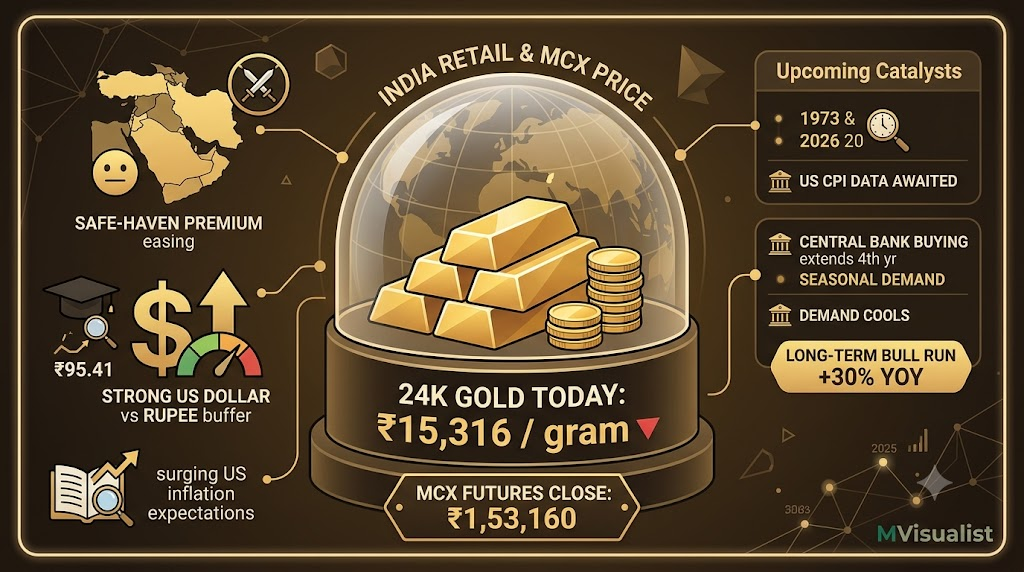
Aaj Ka Sone Ka Bhav:
₹15,316 Per Gram
24K gold pulls back in India amid a rising dollar and surging US inflation expectations — but at 30%+ year-on-year gains, sona remains one of India’s best-performing assets of 2026.
Gold Price Today Across Major Indian Cities
Gold prices differ city-to-city in India due to local demand, transport costs, state taxes, and the policies of regional gold associations. Here are today’s indicative rates for the 10 most-watched markets:
| City | 24K (per gram) | 22K (per gram) | 18K (per gram) | 24K (per 10g) |
|---|---|---|---|---|
Delhi | ₹15,332 | ₹14,056 | ₹11,503 | ₹1,53,320 |
Mumbai | ₹15,310 | ₹14,034 | ₹11,483 | ₹1,53,100 |
Chennai | ₹15,340 | ₹14,062 | ₹11,505 | ₹1,53,400 |
Bangalore | ₹15,316 | ₹14,040 | ₹11,487 | ₹1,53,160 |
Hyderabad | ₹15,316 | ₹14,040 | ₹11,487 | ₹1,53,160 |
Ahmedabad | ₹15,320 | ₹14,044 | ₹11,490 | ₹1,53,200 |
Kolkata | ₹15,316 | ₹14,040 | ₹11,487 | ₹1,53,160 |
Pune | ₹15,310 | ₹14,034 | ₹11,483 | ₹1,53,100 |
Jaipur | ₹15,324 | ₹14,047 | ₹11,493 | ₹1,53,240 |
Surat | ₹15,318 | ₹14,042 | ₹11,489 | ₹1,53,180 |
💡 Why Do Prices Differ Between Cities?
Transport & Carriage: India imports most gold by sea. Port cities like Mumbai and Chennai have lower freight costs than inland cities like Delhi and Jaipur.
Local Demand: High-volume markets (Mumbai’s Zaveri Bazaar) often get better rates than smaller markets.
Local Associations: Regional jewellers’ associations publish reference rates that can vary slightly from the national IBJA benchmark.
Taxes: State-level levies and local VAT can push prices marginally higher in certain regions.
Why Is Gold Down This Week in India?
Indian gold prices are mirroring a global pullback. After surging to record highs in early 2026, gold has corrected roughly 10% over the past month — and Indian retail prices have followed suit through the USD/INR exchange rate, which is the primary transmission belt between global spot prices and domestic rates.
Three forces are pressing gold lower right now. First, the US Federal Reserve is now facing a 70% market-implied probability of a rate hike in December 2026 — not a cut — following a stronger-than-expected May jobs report (172,000 jobs added). Second, the US dollar has strengthened, pushing USD/INR above ₹95, which means India pays more rupees for each ounce of imported gold, yet global dollar prices are falling faster, resulting in a net dip in rupee prices. Third, the Iran-Israel ceasefire has partially eased geopolitical safe-haven demand.
“Gold’s structural bull drivers — central bank accumulation, fiscal stress, geopolitical uncertainty, and eroding confidence in fiat money — remain firmly in place. The current pullback is near-term noise in a longer-term rally.” — Metals Focus, Gold Focus 2026
Despite the dip, Indian investors who bought gold in June 2025 are sitting on gains of over 30% year-on-year — a performance that rivals even the best equity mutual fund returns over the same period.
USD/INR Rate
The rupee at ₹95.41/USD is the most direct driver of domestic gold prices. Dollar strength means cheaper global gold but an expensive import cost in rupees.
RBI Policy
The RBI held the repo rate steady at 5.25% on June 5, citing a revised CPI forecast of 5.1%. Stable rates reduce opportunity cost of holding gold.
Import Duty
India’s basic customs duty on gold imports significantly affects domestic prices, adding a premium over international rates beyond just freight and GST.
Wedding Season
Post-Akshaya Tritiya demand has cooled for now. The next major demand spike is expected around the festive and wedding season beginning October 2026.
Equity Markets
Sensex above 73,900 is steady. When equities are volatile, investors rotate into gold. Stable markets currently reduce panic-driven gold demand.
Global Spot (XAU/USD)
International gold at $4,344/oz has fallen 10% in a month. India tracks this with a lag, adjusted for the rupee rate and import premiums.
Best Ways to Invest in Gold in India (2026)
India offers more gold investment options than almost any country in the world — from traditional jewellery to RBI-backed bonds. Here is how each stacks up:
Sovereign Gold Bonds (SGBs)
RBI-issued bonds paying 2.5% annual interest on top of gold price gains. Capital gains are fully tax-free if held to maturity (8 years). No storage cost. Note: New issuances have been paused since March 2026 — secondary market is now the main access route.
Gold ETFs
Units representing 24K gold held in vaults, traded on NSE/BSE via a demat account. Highly liquid, no storage risk, ideal for 2–5 year investors. LTCG taxed at 12.5% (held >24 months).
Gold Coins & Bars
Tangible ownership with BIS Hallmark (6-digit HUID mandatory in 2026). Best for those who want physical custody. Adds storage, insurance, and locker costs.
Digital Gold
Buy from ₹1 on apps like GPay, PhonePe. Backed by 99.9% physical gold in secured vaults. Convenient for beginners but lacks SEBI regulation. Taxed at 30%. Best for small, short-term purchases only.
Gold Jewellery
India’s default. Carries 3% GST + making charges (8–25%) + wastage. Poor as a pure investment due to buy-sell spread. Best when jewellery itself is the purpose.
Gold Mining Funds
Gold fund-of-funds investing in global mining stocks. Offers leveraged gold exposure. Available via mutual fund platforms — no demat needed.
Gold Taxation in India: What You Need to Know
Post the Finance Act 2024 amendments, gold taxation has been simplified but requires careful attention based on how and how long you hold:
| Investment Type | Holding Period | Tax Treatment |
|---|---|---|
| Physical Gold / Gold ETF | Under 24 months | STCG — added to income, taxed at slab rate |
| Physical Gold / Gold ETF | Over 24 months | LTCG — flat 12.5% (without indexation) |
| SGB (original subscriber) | Held to maturity (8 yrs) | ✅ Capital gains FULLY EXEMPT |
| SGB (secondary market purchase) | Any period | Capital gains taxed normally (as per Finance Act 2026) |
| Digital Gold | Any period | 30% flat tax on gains |
| SGB Interest Income | All SGBs | Taxable at applicable income slab rate |
⚠️ Tax laws are subject to change. Consult a CA or tax advisor before making investment decisions.
Tips for Buying Gold Jewellery in India
🔍 Always Check for BIS Hallmark (HUID)
Since 2021, BIS Hallmarking is mandatory across India. In 2026, it is enforced in almost all districts. Always look for the 6-digit HUID (Hallmark Unique Identification) number stamped on jewellery. You can verify it on the BIS Care app.
Purity marks to know: 999 = 24K · 916 = 22K · 750 = 18K · 585 = 14K
Making charges matter: Jewellers charge 8–25% over the gold rate as making charges. Machine-made jewellery typically has lower making charges (8–12%) than handcrafted pieces.
Best time to buy: Gold is typically cheaper during non-peak periods (post-Diwali, post-Dhanteras). Avoid buying at the peak of wedding season (Nov–Feb, Apr–May).
Frequently Asked Questions
What is the gold rate in India today?
As of June 10, 2026, 24K gold is trading at approximately ₹15,316 per gram (₹1,53,160 per 10g) and 22K at ₹14,040 per gram (₹1,40,400 per 10g). Prices vary by city.
Why is 22K cheaper than 24K gold?
22K gold is 91.6% pure (the remainder is copper or silver for durability), while 24K is 99.9% pure. 22K is preferred for jewellery because it is harder and more durable. The price difference reflects the purity difference.
Is this a good time to buy gold in India?
Gold has corrected 10% in the past month, which many analysts view as a healthy consolidation rather than a trend reversal. Long-term structural drivers — central bank buying, inflation hedging, geopolitical risk — remain intact. For investors with a 3–8 year horizon, current levels may represent a meaningful entry point.
Are Sovereign Gold Bonds still available?
New SGB issuances from the RBI have been paused as of March 2026 with no FY2026–27 calendar announced. However, you can still buy existing SGBs on the secondary market (BSE/NSE) through a demat account, though capital gains tax exemptions now apply only to original subscribers who hold to maturity.
How is gold price calculated in India?
India’s domestic gold price = Global XAU/USD spot price × USD/INR exchange rate + Import duty + GST (3%) + local association premiums and transport charges. MCX serves as the primary domestic benchmark.
What is the gold price per tola in India today?
One tola = 11.6638 grams. At today’s rate of ₹15,316/gram for 24K gold, one tola is approximately ₹1,78,579. This unit is commonly used by older jewellers and in the wholesale bullion trade.
Outlook: Where Is Indian Gold Headed?
Short-Term Headwinds, Long-Term Story Intact
Indian gold investors are navigating a short-term correction driven by external macro forces — a hawkish US Federal Reserve and a stronger dollar — rather than any fundamental weakness in gold’s own story.
The rupee’s depreciation past ₹95/USD partially cushions the fall for Indian investors: even as global dollar prices decline, rupee-priced gold does not fall by as much. This natural hedge is one of gold’s unique advantages in India.
Looking ahead, the festive and wedding season (October–February) historically brings a seasonal demand surge in India. If global gold stabilises or rebounds toward JP Morgan’s $6,300 target and the rupee weakens further, domestic prices could push significantly higher by year-end.
Watch This Month: US CPI data (Wednesday), RBI’s stance on inflation, and INR movement. A weaker rupee could support Indian gold prices even if global prices remain flat.