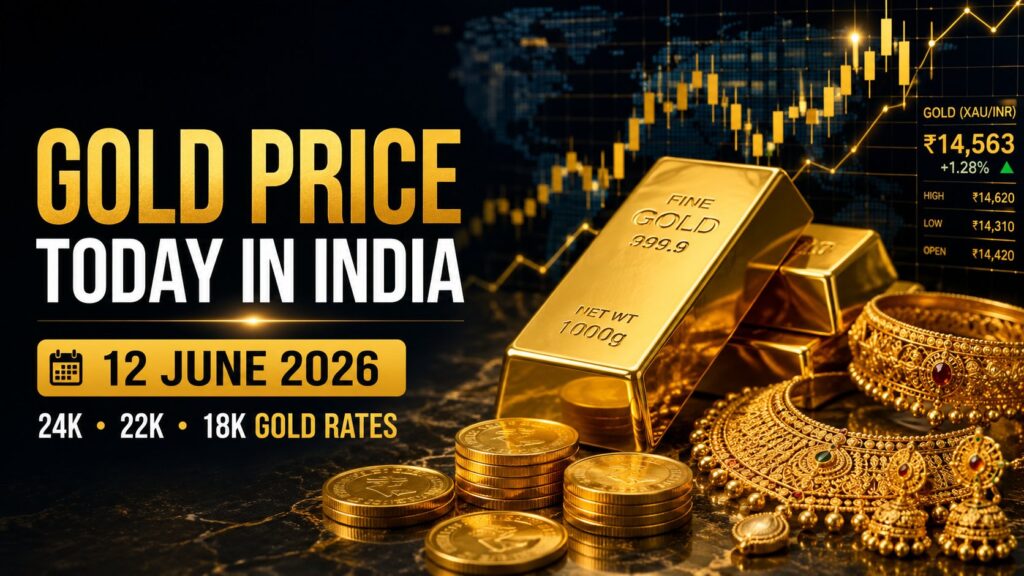
Gold Price Today
in India —
12 June 2026
MCX crashed 2.3% as a stronger US dollar and hawkish Fed expectations weigh on gold. Here is every number, every reason, and every smart move you need to know today.
Gold Rate Today in India — 12 June 2026: The Complete Picture
Gold in India is continuing its sharpest correction of 2026. MCX gold futures have crashed 2.3%, closing at ₹1,48,955 per 10 grams — down from the staggering all-time high of ₹1,92,991 set in January 2026. Retail 24K gold is at ₹14,563/gram and 22K at ₹13,349/gram.
According to GoodReturns and BusinessToday, today’s gold and silver prices in India fell slightly across major cities on 12 June 2026. The precious metal has now declined for several consecutive sessions, reflecting a combination of a strengthening US dollar, elevated US Treasury yields, and cautious investor sentiment ahead of critical US economic data releases this week.
MCX Gold Crashed 2.3% on 11 June — Continuing Today
Gold and silver futures on MCX crashed sharply due to a strengthening US dollar and elevated global oil prices. Gold ended at ₹1,48,955 per 10 grams on 11 June. Today’s session continues in similar territory. Markets are in wait-and-watch mode ahead of the US CPI and PPI data releases this week.
Despite the near-term pain, the year-on-year picture remains exceptional. Gold in India has risen from around ₹9,747/gram in June 2025 to approximately ₹14,563/gram today — a gain of nearly 49%. Gold scripted history on 29 January 2026, surging to an all-time high of ₹1,78,850 per 10g in retail markets with MCX futures briefly touching ₹1,92,991 per 10g intraday, driven by geopolitical tensions, a Fed rate pause, and strong safe-haven demand.
Gold Price Today Across Major Indian Cities — 12 June 2026
Gold prices are not uniform across India. They vary due to state taxes, transportation costs from import ports, local jeweller association premiums, and city-level demand. Here are today’s indicative retail rates across 12 key Indian markets:
| City / State | 24K / Gram | 22K / Gram | 18K / Gram | 24K / 10 Grams | Per Tola |
|---|---|---|---|---|---|
Delhi, NCR | ₹14,600 | ₹13,382 | ₹10,950 | ₹1,46,000 | ₹1,70,291 |
Mumbai, MH | ₹14,563 | ₹13,349 | ₹10,922 | ₹1,45,630 | ₹1,69,859 |
Chennai, TN | ₹14,700 | ₹13,475 | ₹11,025 | ₹1,47,000 | ₹1,71,458 |
Bangalore, KA | ₹14,570 | ₹13,355 | ₹10,928 | ₹1,45,700 | ₹1,69,941 |
Hyderabad, TS | ₹14,563 | ₹13,349 | ₹10,922 | ₹1,45,630 | ₹1,69,859 |
Ahmedabad, GJ | ₹14,570 | ₹13,355 | ₹10,928 | ₹1,45,700 | ₹1,69,941 |
Kolkata, WB | ₹14,563 | ₹13,349 | ₹10,922 | ₹1,45,630 | ₹1,69,859 |
Pune, MH | ₹14,563 | ₹13,349 | ₹10,922 | ₹1,45,630 | ₹1,69,859 |
Jaipur, RJ | ₹14,580 | ₹13,365 | ₹10,935 | ₹1,45,800 | ₹1,70,059 |
Surat, GJ | ₹14,565 | ₹13,351 | ₹10,924 | ₹1,45,650 | ₹1,69,882 |
Lucknow, UP | ₹14,595 | ₹13,378 | ₹10,946 | ₹1,45,950 | ₹1,70,233 |
Kochi, KL | ₹14,580 | ₹13,365 | ₹10,935 | ₹1,45,800 | ₹1,70,059 |
* All rates are indicative, sourced from IBJA, GoodReturns & AllIndiaBullion. Retail prices at jewellers will include 3% GST + making charges (8–25%). 1 Tola = 11.6638 grams. Verify with your local jeweller before transacting.
📌 Why Do Gold Prices Differ Between Indian Cities?
- Port proximity: India imports gold primarily by sea. Port cities like Mumbai and Chennai bear lower freight costs, giving them a price advantage over inland cities like Delhi and Jaipur.
- Local association benchmarks: Regional jewellers’ associations (e.g., the Tamil Nadu Jewellers Association) can set reference rates that deviate slightly from the national IBJA benchmark.
- State taxes & octroi: Some states impose local levies, entry taxes, or have varying fuel-cost profiles that feed into the delivered cost of gold.
- Volume & wholesale access: High-volume trading hubs like Mumbai’s Zaveri Bazaar access tighter wholesale spreads, which don’t always translate to lower retail prices.
24K Gold Price by Weight — 12 June 2026 (National Average)
Planning a purchase, comparing jewellery pricing, or calculating an investment? Here is today’s gold price across all common weights at the national average of ₹14,563/gram for 24K:
| Weight | 24K Price | 22K Price | 18K Price |
|---|---|---|---|
| 1 Gram | ₹14,563 | ₹13,349 | ₹10,922 |
| 2 Grams | ₹29,126 | ₹26,698 | ₹21,844 |
| 4 Grams | ₹58,252 | ₹53,396 | ₹43,688 |
| 5 Grams | ₹72,815 | ₹66,745 | ₹54,610 |
| 8 Grams | ₹1,16,504 | ₹1,06,792 | ₹87,376 |
| 10 Grams | ₹1,45,630 | ₹1,33,490 | ₹1,09,220 |
| 1 Tola (11.66g) | ₹1,69,805 | ₹1,55,649 | ₹1,27,314 |
| 20 Grams | ₹2,91,260 | ₹2,66,980 | ₹2,18,440 |
| 50 Grams | ₹7,28,150 | ₹6,67,450 | ₹5,46,100 |
| 100 Grams | ₹14,56,300 | ₹13,34,900 | ₹10,92,200 |
| 500 Grams | ₹72,81,500 | ₹66,74,500 | ₹54,61,000 |
| 1 Kilogram | ₹1,45,63,000 | ₹1,33,49,000 | ₹1,09,22,000 |
* All prices are indicative and exclude GST (3%), TCS, making charges & jeweller premiums. Final purchase price will always be higher than listed rates.
Why Is Gold Price Falling in India in June 2026?
Gold on MCX has fallen nearly 23% from its all-time high of ₹1,92,991/10g set in January 2026. The correction accelerated last week after a series of interconnected global triggers. Here is a clear breakdown.
The sell-off in MCX gold futures is directly linked to a sharp reset in US interest rate expectations. After months of expecting the Federal Reserve to cut rates aggressively in 2026, investors were blindsided by a stronger-than-expected US May jobs report that showed the economy adding 172,000 jobs — significantly exceeding market expectations. This single data print forced markets to reprice gold substantially.
On the domestic front, gold ETFs saw a record outflow of ₹725 crore in May 2026 — the first outflow of 2026 — suggesting Indian investors are beginning to book profits at elevated levels. Silver ETFs, meanwhile, attracted ₹2,133 crore in the same period, indicating a rotation rather than outright exit from precious metals.
US Fed Rate Hike Risk
Markets are now pricing a possible Fed rate hike by year-end 2026 — a dramatic reversal from earlier expectations of cuts. Higher rates make bonds attractive vs. non-yielding gold, eroding demand.
Strong US Dollar (DXY)
Rising US Treasury yields have boosted the dollar index. Since gold is priced globally in USD, a stronger dollar makes gold more expensive for non-US buyers, suppressing international demand and spot prices.
Gold ETF Outflow
Gold ETFs in India saw a record ₹725 crore outflow in May 2026 — their first outflow of the year. Institutional profit-booking at elevated levels is creating a supply overhang in domestic markets.
US CPI & PPI Data (This Week)
Market focus shifts to US Consumer and Producer Price Index data this week. A softer CPI reading could ease rate-hike fears and trigger a sharp gold rebound. A hot print sends gold lower.
Geopolitical Ebbs & Flows
US-Iran tensions remain elevated — US military actions and Strait of Hormuz concerns continue. Any sharp escalation can trigger safe-haven demand and reverse the gold correction swiftly.
Rupee Cushion (₹95.27/$)
A weaker rupee acts as a partial cushion for Indian gold buyers — when the dollar rises and rupee falls simultaneously, domestic gold price declines are smaller than global dollar-price falls. This has protected Indian investors somewhat.
Central Bank Buying
Global central banks continue accumulating gold into 2026, extending a multi-year buying streak. This structural demand floor prevents gold from collapsing despite near-term selling pressure.
India Festive Season Ahead
Post-Akshaya Tritiya demand has cooled. However, the festive and wedding season starting October 2026 — Navratri, Dhanteras, Diwali, winter weddings — will bring a significant seasonal demand surge for physical gold in India.
Gold Price Forecast — June & Year-End 2026
Where are analysts and major institutions expecting gold to go from here? Here is a consolidated view of current forecasts:
| Institution / Source | June 2026 Range | Year-End 2026 Target | Stance |
|---|---|---|---|
| LiteFinance | $4,059–$4,157 (this week) | $3,816–$4,370 | Bearish near-term |
| Choice India (MCX) | Above 200-DEMA ₹1,49,121 | ₹1,55,600+ on bounce | Cautiously bullish |
| ICICI Direct | Correction = accumulation | Long-term bullish | Strategic buy on dips |
| Bajaj Finserv | High volatility; upward trend | Firm with inflation hedge | Structurally bullish |
| JP Morgan (Global) | $4,000–$4,500 | $6,300 | Strongly Bullish |
| UBS (Global) | $4,000–$4,500 | $6,200 | Bullish |
| Deutsche Bank (Global) | Volatile | $6,000 | Bullish |
📌 Key Technical Levels to Watch on MCX
Major support: ₹1,49,121 (200-Day EMA) — gold is currently testing this level. A hold here is constructive.
Resistance: ₹1,55,600 — first meaningful resistance if gold bounces. Reclaiming this level would signal trend reversal.
Bull trigger: US CPI coming in softer than expected (below 4.0%) could be the catalyst for a sharp rebound toward ₹1,55,000–₹1,58,000 on MCX.
Bear risk: A hot CPI print (above 4.5%) combined with fresh hawkish Fed commentary could push MCX gold toward the ₹1,40,000–₹1,42,000 support zone.
How to Invest in Gold in India — Best Options for Every Type of Investor
India offers more ways to own gold than almost any country in the world — from millennia-old physical traditions to SEBI-regulated digital instruments. Here is a complete expert breakdown of each route:
Sovereign Gold Bonds (SGBs)
Issued by the RBI, SGBs pay 2.5% annual interest semi-annually on top of gold price appreciation. Capital gains are completely tax-exempt at maturity (8 years) for original subscribers — the best tax treatment of any gold instrument in India. Key 2026 note: New SGB tranches are paused for FY2026–27; buy only via secondary market on BSE/NSE. Secondary market purchasers lose the capital gains exemption as per Budget 2026 amendments.
Gold ETFs
Exchange-traded funds backed 1:1 by physical 24K gold in custodian vaults. Listed on NSE/BSE. No storage cost, no making charges, no counterparty risk beyond the fund. LTCG taxed at 12.5% after 24 months. Ideal for investors wanting flexibility and liquidity over a 2–5 year horizon. Gold ETFs saw ₹725 Cr outflow in May 2026 — short-term bearish signal, but not a structural exit.
Gold Coins & Bars
Tangible gold ownership. BIS Hallmark (6-digit HUID) is mandatory since 2021. Available from banks, India Post, and certified jewellers. No counterparty risk, but requires bank locker (₹3,000–₹8,000/year) plus insurance. High buy-sell spreads make it inefficient for trading. Best for those wanting physical custody of their savings.
Gold Jewellery
India’s default gold format. 3% GST plus making charges (8–25%) make this the most expensive route to own gold. Resale deducts wastage and re-touching fees. Best purchased when the jewellery itself is the purpose. Not recommended as a primary investment instrument due to high acquisition cost and poor resale economics.
Digital Gold
Buy from ₹1 on GPay, PhonePe, or Paytm. Backed by 99.9% 24K gold in insured vaults. Highly convenient; no SEBI regulation. Taxed at a flat 30% on all gains — the highest tax rate of any gold investment option. Storage fees may apply after 5 years. Best for small, short-term, or first-time purchases only. Not suitable for wealth creation.
Gold Mutual Funds
Fund-of-funds that invest in Gold ETFs. No demat account required — accessible via Groww, Zerodha Coin, MFCentral. Can be SIP’d from as low as ₹500/month. Slightly higher expense ratio vs. direct ETFs. LTCG taxed at 12.5% after 24 months. Best for beginners or salaried investors wanting systematic gold accumulation.
SGB vs Gold ETF vs Physical — Side-by-Side
Select an option to compare across 7 key criteria.
Gold Taxation in India — Complete 2026 Rules
The Finance Act 2024 and Budget 2026 both introduced changes to gold taxation. Understanding these rules can save lakhs over a long holding period. Here is the definitive table:
| Gold Type | Holding Period | Tax Rate | Key Notes |
|---|---|---|---|
| Physical Gold / Gold ETF | Under 24 months | Slab rate (STCG) | Added to income; taxed at your income tax bracket |
| Physical Gold / Gold ETF | Over 24 months | 12.5% (LTCG) | No indexation benefit post Finance Act 2024 |
| SGB — Original Subscriber | Held to 8-yr maturity | ZERO — Fully Exempt | Best tax treatment available; capital gains fully tax-free |
| SGB — Secondary Purchase | Any period | Normal LTCG/STCG | Budget 2026: exemption removed for secondary buyers |
| Digital Gold | Any | 30% flat | No indexation; similar treatment to crypto/VDA |
| SGB Interest Income | All tenors | Slab rate | Taxable every year; TDS deducted at source |
| Inherited Jewellery | — | Cost = FMV at inheritance date | Original holding period from first owner’s purchase date |
⚠️ Tax laws are subject to change each Budget. Always verify with a CA or SEBI-registered investment advisor before making investment decisions.
How to Buy Gold in India Smartly — 2026 Checklist
Whether you’re buying jewellery at a local store or coins through a bank, these seven steps will protect you from overpaying and ensure you get genuine, documented gold:
Check Today’s Spot Rate First
Before entering a jewellery store, look up the current IBJA reference rate (ibja.co.in) or check GoodReturns for your city. This gives you the base price to negotiate from — making charges and GST are added on top.
Demand BIS Hallmark with HUID
Every piece of gold jewellery sold in India must carry a BIS Hallmark with a 6-digit HUID (Hallmark Unique ID). Verify it on the BIS Care app (free). The purity stamps to know: 999 = 24K, 916 = 22K, 750 = 18K, 585 = 14K.
Understand Making Charges
Machine-made jewellery: 8–12% making charges. Handcrafted/designer pieces: 15–25%. For investment purposes, buy coins or bars (0.5–2% making charges). Never conflate the gold value with the jewellery cost.
Account for 3% GST + TCS
3% GST is levied on all gold purchases in India. For purchases above ₹2 lakh, 1% TCS (Tax Collected at Source) also applies and can be adjusted against your income tax liability. This is non-negotiable and must appear on your bill.
Get a Detailed Bill
A valid gold purchase bill must list: gold weight (in grams), purity (karat), making charges (separately), HUID, GST amount, and the jeweller’s GST registration number. Retain this bill — you’ll need it for tax purposes on resale.
Time Your Purchase Smartly
Gold in India is typically cheapest post-Diwali through January. The most expensive times to buy are Akshaya Tritiya (April–May), Dhanteras (October–November), and the winter wedding season (November–February). If you can wait, avoid peak demand periods.
Consider Investment vs Jewellery Separately
If your goal is financial returns, opt for SGBs, Gold ETFs, or hallmarked coins — not jewellery. If your goal is jewellery for wearing or gifting, buy what you love. Mixing investment goals with jewellery purchases almost always results in suboptimal financial outcomes.
Frequently Asked Questions — Gold Price in India
What is the gold rate today in India on 12 June 2026?
Why is gold price falling so sharply in India in June 2026?
Is this a good time to buy gold in India?
What is the difference between 22K and 24K gold?
Are Sovereign Gold Bonds still available in 2026?
How is gold price in India calculated?
What is the gold price per tola in India today?
Expert Outlook: Where Is Indian Gold Headed?
A Painful Correction, but the Architecture of the Bull Market Remains Intact
India’s gold market is navigating its sharpest correction since the January 2026 all-time highs. MCX gold, which briefly touched ₹1,92,991 per 10 grams intraday on 29 January, now sits near ₹1,48,955 — a fall of nearly 23% from peak. That is painful. But it is worth keeping two things in perspective.
First, gold in India is still up approximately 49% year-on-year. Investors who bought a year ago at ₹9,747/gram are sitting on extraordinary gains despite the recent correction. The metal has been one of the best-performing assets of any class in India in the 12 months ending June 2026.
Second, the structural forces driving gold higher — four consecutive years of central bank buying, global debt exceeding $340 trillion, a multipolar geopolitical environment with active US-Iran tensions, and deep-rooted concerns about fiat currency purchasing power — have not disappeared. These are decade-long shifts, not month-to-month noise.
The near-term risk is real and concentrated in one variable: US interest rate expectations. If the Fed hikes rates in December 2026 and the dollar strengthens further, gold will face continued pressure. But if the CPI data this week comes in below expectations, markets will sharply reverse their hawkish bets and gold could rebound to ₹1,55,000–₹1,60,000 on MCX rapidly.
For Indian investors specifically: the rupee’s structural weakening against the dollar provides a built-in buffer on the downside. Even in scenarios where global gold falls modestly in dollar terms, rupee-priced Indian gold may remain relatively supported.