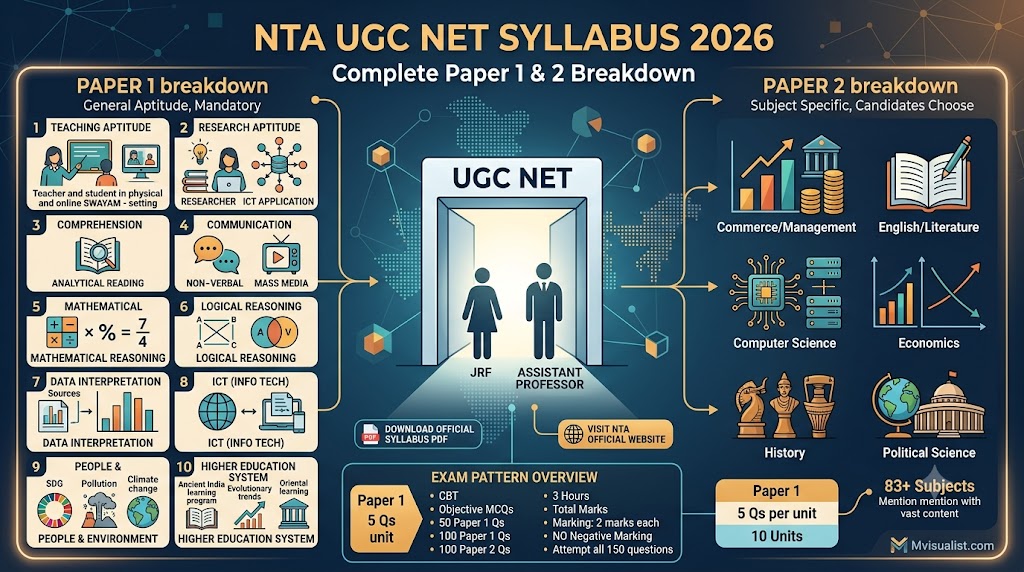
NTA UGC NET Syllabus 2026:
Complete Paper 1 & 2 Breakdown
The University Grants Commission National Eligibility Test (UGC NET) is the gateway for Indian nationals seeking the Junior Research Fellowship (JRF) and Assistant Professor positions. Success begins with a masterful understanding of the syllabus.
Conducted by the National Testing Agency (NTA), the UGC NET is a highly competitive computer-based test (CBT). To outpace the competition, aspirants must intimately decode the syllabus. The examination is strictly divided into two papers: Paper 1 (General Aptitude) and Paper 2 (Subject Specific). Let’s dive into the detailed, unit-wise syllabus.
1. UGC NET Exam Pattern Overview
Before analyzing the syllabus, you must understand the structure of the battlefield. Both papers consist of objective-type, multiple-choice questions (MCQs). There is no break between the two papers.
| Paper | Number of Questions | Total Marks | Duration |
|---|---|---|---|
| Paper 1 Teaching & Research Aptitude | 50 | 100 | 3 Hours (180 Minutes) Without Break |
| Paper 2 Subject Chosen by Candidate | 100 | 200 |
Crucial Marking Scheme Note
Every correct answer fetches 2 marks. Fortunately, there is NO negative marking for incorrect responses. Candidates are strongly advised to attempt all 150 questions.
2. Detailed Syllabus: Paper 1 (General Paper on Teaching & Research Aptitude)
Paper 1 is common and mandatory for all candidates. Its primary objective is to assess the teaching and research capabilities of the candidates. The syllabus is meticulously divided into 10 Units. The NTA mandates that 5 questions (carrying 2 marks each) will be set from each of the 10 units.
Teaching Aptitude
- Teaching: Concept, Objectives, Levels of teaching, Characteristics.
- Learner’s characteristics (Adolescent and Adult).
- Factors affecting teaching.
- Methods of teaching in Institutions of higher learning (Teacher vs Learner centered, Offline vs Online – Swayam, Swayamprabha, MOOCs).
- Evaluation Systems & Choice Based Credit System (CBCS).
Research Aptitude
- Research: Meaning, Types, and Characteristics, Positivism and Post-positivistic approach.
- Methods of Research: Experimental, Descriptive, Historical, Qualitative and Quantitative.
- Steps of Research.
- Thesis and Article writing: Format and styles of referencing.
- Application of ICT in research; Research ethics.
Comprehension
A passage of text is given. Questions are asked from the passage to be answered. Tests analytical reading and grasping core concepts quickly.
Communication
- Communication: Meaning, types, and characteristics.
- Effective communication: Verbal and Non-verbal, Inter-Cultural, Group communication.
- Barriers to effective communication.
- Mass-Media and Society.
Mathematical Reasoning
- Types of reasoning.
- Number series, Letter series, Codes, and Relationships.
- Mathematical Aptitude: Fraction, Time & Distance, Ratio, Proportion, Percentage, Profit & Loss, Interest, Averages.
Logical Reasoning
- Structure of arguments, classical square of opposition.
- Deductive and inductive reasoning.
- Venn diagram.
- Indian Logic: Means of knowledge (Pramanas – Anuamana, Upamana, Shabda, Arthapatti, Anupalabdhi).
Data Interpretation
- Sources, acquisition, and classification of Data.
- Quantitative and Qualitative Data.
- Graphical representation (Bar-chart, Histograms, Pie-chart, Table-chart) and mapping of Data.
- Data and Governance.
ICT (Information Tech)
- ICT: General abbreviations and terminology.
- Basics of Internet, Intranet, E-mail, Audio and Video-conferencing.
- Digital initiatives in higher education.
- ICT and Governance.
People, Dev. & Environment
- Millennium development and Sustainable development goals.
- Human and environment interaction.
- Environmental issues: Air, Water, Soil, Noise pollution, Climate change.
- Impacts of pollutants on human health.
- Natural hazards, disasters, and mitigation strategies.
Higher Education System
- Institutions of higher learning and education in ancient India.
- Evolution of higher learning and research in Post Independence India.
- Oriental, Conventional and Non-conventional learning programmes in India.
- Professional, Technical and Skill Based education. Value education.
3. Syllabus: Paper 2 (Subject Specific)
Paper 2 assesses the candidate’s in-depth, post-graduate level knowledge in their chosen subject. The NTA currently conducts the UGC NET in 83+ subjects, including major disciplines like Commerce, Management, English, Computer Science, Economics, History, and Political Science.
Because the syllabus for each of the 83 subjects is vast, candidates are required to download their specific subject syllabus directly from the official UGC NET portal. The syllabus is available in both English and Hindi mediums.
Official Action Links
Access the authentic syllabus PDFs for all 83 subjects directly from the UGC NET portal. Stay updated with the official NTA website for exam dates and notifications.
All links are configured to open securely in this window.
Frequently Asked Questions (FAQs)
The UGC periodically updates the syllabus to keep pace with modern academic developments. While the core structure remains similar to the 2019 revision, it is highly recommended to download the latest PDF from the official ugcnetonline.in portal using the button above to ensure you aren’t studying outdated topics.
No. Currently, there is absolutely no negative marking for incorrect answers in either Paper 1 or Paper 2. Candidates are strongly encouraged to attempt all 150 questions to maximize their scoring potential.
No electronic devices, including calculators or smartwatches, are permitted inside the examination hall. Candidates must rely on mental math and manual calculations on the rough sheets provided by the invigilators.
Disclaimer of Authenticity
Mvisualist.com is an independent educational platform dedicated to assisting students. We are not officially affiliated with the University Grants Commission (UGC) or the National Testing Agency (NTA). The syllabus breakdown and exam patterns provided above are for informational and preparatory purposes. Candidates must always verify the latest syllabus and rules directly on the official NTA website.