Gold Price Today in India
11 June 2026
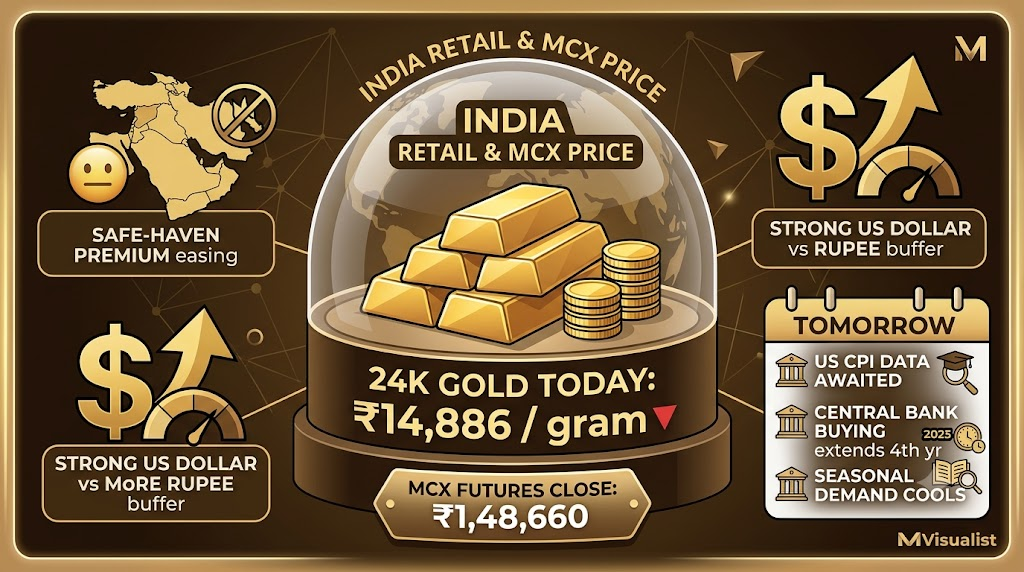
24K gold trades at ₹14,886/gram as MCX corrects sharply from June highs. Get live city-wise rates, full market analysis, and the smartest ways to invest in gold in 2026.
Sources: GoodReturns · BusinessToday · MCX · IBJA · Prices as of 11 June 2026 · Indicative only — exclude GST, TCS, making charges
Gold Rate Today in India — 11 June 2026: Complete Snapshot
Gold is trading sharply lower in India today. After hitting highs of ₹1,59,400 per 10 grams on 2 June, the precious metal has corrected to around ₹1,48,660 on MCX — a fall of over ₹10,000 per 10 grams in just eight trading sessions.
According to GoodReturns and BusinessToday, retail gold prices across India on 11 June 2026 stand at approximately ₹14,886 per gram for 24K gold and ₹13,645 per gram for 22K gold. Silver is trading around ₹2,50,000 per kilogram. On the Multi Commodity Exchange (MCX), gold futures are hovering in the ₹1,53,400 to ₹1,54,600 band, reflecting continued selling pressure.
The correction is driven by a combination of factors: hawkish US Federal Reserve signals, a strong dollar pushing USD/INR above ₹95.46, and an easing in West Asia tensions after US-brokered dialogue between Iran and Israel. Markets are now anxiously waiting for the US CPI data, which could determine whether gold bounces back or falls further.
MCX Gold — Price Journey, June 2026 (per 10g)
Gold Rate Today Across Major Indian Cities — 11 June 2026
India does not have a single uniform gold price. Rates vary city-to-city because of local taxes, freight costs from ports, jeweller association premiums, and demand dynamics. The table below gives indicative retail prices for 10 major cities:
| City | 24K / Gram | 22K / Gram | 18K / Gram | 24K / 10g | Per Tola |
|---|---|---|---|---|---|
Delhi | ₹14,940 | ₹13,695 | ₹11,205 | ₹1,49,400 | ₹1,74,240 |
Mumbai | ₹14,886 | ₹13,645 | ₹11,164 | ₹1,48,860 | ₹1,73,610 |
Chennai | ₹15,055 | ₹13,800 | ₹11,291 | ₹1,50,550 | ₹1,75,580 |
Bangalore | ₹14,900 | ₹13,658 | ₹11,175 | ₹1,49,000 | ₹1,73,770 |
Hyderabad | ₹14,886 | ₹13,645 | ₹11,164 | ₹1,48,860 | ₹1,73,610 |
Ahmedabad | ₹14,895 | ₹13,653 | ₹11,171 | ₹1,48,950 | ₹1,73,715 |
Kolkata | ₹14,886 | ₹13,645 | ₹11,164 | ₹1,48,860 | ₹1,73,610 |
Pune | ₹14,886 | ₹13,645 | ₹11,164 | ₹1,48,860 | ₹1,73,610 |
Jaipur | ₹14,920 | ₹13,673 | ₹11,190 | ₹1,49,200 | ₹1,74,005 |
Surat | ₹14,890 | ₹13,649 | ₹11,168 | ₹1,48,900 | ₹1,73,658 |
* Indicative rates sourced from IBJA/GoodReturns. Retail prices at jewellers will include 3% GST + making charges (8–25%). One tola = 11.6638 grams.
📌 Why Gold Prices Differ Between Cities
- Port cities (Mumbai, Chennai): Lower transport costs since India imports gold by sea — gives them a natural price advantage over inland cities.
- Local association rates: Regional jewellers’ associations set reference rates that may deviate slightly from the national IBJA benchmark.
- State-level taxes: Some states have octroi, local levies, or varying fuel costs that feed into the final price.
- Volume & demand: High-volume markets like Zaveri Bazaar (Mumbai) can access wholesale rates unavailable in smaller markets.
24K Gold Price by Quantity — 11 June 2026
Planning a purchase or investment? Here’s how today’s rates stack up across common weights, based on the national average of ₹14,886/gram for 24K gold:
| Weight | 24K Price | 22K Price | 18K Price |
|---|---|---|---|
| 1 Gram | ₹14,886 | ₹13,645 | ₹11,164 |
| 2 Grams | ₹29,772 | ₹27,290 | ₹22,328 |
| 5 Grams | ₹74,430 | ₹68,225 | ₹55,820 |
| 8 Grams | ₹1,19,088 | ₹1,09,160 | ₹89,312 |
| 10 Grams | ₹1,48,860 | ₹1,36,450 | ₹1,11,640 |
| 1 Tola (11.66g) | ₹1,73,552 | ₹1,59,101 | ₹1,30,172 |
| 20 Grams | ₹2,97,720 | ₹2,72,900 | ₹2,23,280 |
| 50 Grams | ₹7,44,300 | ₹6,82,250 | ₹5,58,200 |
| 100 Grams | ₹14,88,600 | ₹13,64,500 | ₹11,16,400 |
| 1 Kilogram | ₹1,48,86,000 | ₹1,36,45,000 | ₹1,11,64,000 |
* Rates are indicative and exclude 3% GST, TCS, making charges, and city-level premiums. Final purchase price will be higher.
Why Is Gold Price Falling in India in June 2026?
Gold has shed over ₹10,000 per 10 grams in eight sessions. Understanding what is behind this correction is essential for any buyer or investor right now.
Gold snapped an eight-day losing streak briefly on 9 June before resuming its decline on 10–11 June. The metal had rallied to ₹1,54,700 on 9 June as West Asian tensions appeared to ease, only for fresh escalation news and strong US dollar momentum to push it back below ₹1,49,000 again.
US Fed Rate Hike Fears
Markets are pricing a ~70% chance of a December 2026 Fed rate hike after a strong May jobs report (172,000 new jobs). Higher US rates make bonds more attractive vs. non-yielding gold.
Strong US Dollar (DXY)
The DXY index has strengthened significantly, making gold more expensive for non-dollar buyers globally, suppressing demand and prices.
Iran-Israel Ceasefire Talks
Easing West Asian tensions have reduced gold’s safe-haven premium. But fresh US military actions in the region (11 June) are re-injecting uncertainty — watch this space closely.
Rupee Weakening
USD/INR above ₹95.46 is a double-edged factor: it partially buffers Indian gold buyers from the global dollar decline, making domestic price drops smaller than global ones.
US CPI Data (Awaited)
Markets are in wait-and-watch mode ahead of the US May CPI print. A softer reading could ease rate-hike fears and trigger a sharp gold rebound; a hotter print pushes gold lower.
Central Bank Buying
Global central banks are extending gold accumulation into a fourth consecutive year, providing a structural demand floor. India’s own RBI gold reserves continue to grow.
RBI Holds Rate at 5.25%
The RBI held the repo rate unchanged on 5 June 2026. Stable domestic rates keep the opportunity cost of holding gold contained, supporting domestic demand.
Seasonal Demand
Post-Akshaya Tritiya (May) demand has cooled. The next demand surge is expected from October–November with Dhanteras, Diwali, and the winter wedding season.
How to Invest in Gold in India — Best Options in 2026
India offers more ways to own gold than almost any market in the world. Here is an expert breakdown of every major route — their strengths, weaknesses, and who they best suit:
Sovereign Gold Bonds (SGBs)
Issued by the RBI on behalf of the Government, SGBs pay 2.5% annual interest semi-annually on top of gold price appreciation. Capital gains are fully exempt at maturity (8 years) for original subscribers — a tax advantage unmatched by any other gold investment. Key 2026 change: new SGB issuances are paused for FY2026–27; secondary market (BSE/NSE) is now the main buying route, but secondary purchasers lose the capital gains exemption per Budget 2026.
Gold ETFs
Exchange-traded funds backed by 24K physical gold in custodian vaults. Traded live on NSE/BSE. Ideal for 2–5 year investors wanting liquidity without storage hassle. LTCG taxed at 12.5% if held over 24 months. No making charges or storage fees — low-cost route.
Gold Coins & Bars
Direct physical ownership. Mandatory BIS Hallmark (6-digit HUID) from 2021. Buy from banks, jewellers, or India Post. No counterparty risk, but storage (locker ~₹3,000–8,000/year) and insurance add to total cost. High buy-sell spreads make short-term trading inefficient.
Gold Jewellery
India’s default gold purchase. Excellent as jewellery; poor as pure investment. Making charges (8–25%) and GST (3%) add significantly to acquisition cost. Resale deducts wastage and touch-charges. Worth buying for function, not as financial instrument.
Digital Gold
Buy from as little as ₹1 on GPay, PhonePe, or Paytm. Backed by 99.9% 24K gold in insured vaults. Convenient but lacks SEBI regulation. Taxed at a flat 30% on all gains. Storage fees kick in after 5 years on some platforms. Best for small, short-term purchases only.
Gold Mutual Funds
Fund-of-funds investing in gold ETFs. No demat account needed — ideal for investors without one. Slightly higher expense ratio vs. direct ETFs. Can set up SIPs from ₹500/month. LTCG same as ETF: 12.5% after 24 months.
SGB vs Gold ETF vs Physical Gold — Head-to-Head
Click each tab to compare options across key criteria.
Gold Taxation in India — What’s New in 2026
Tax rules on gold investments were updated in the Finance Act 2024 and further refined in Budget 2026. Understanding these rules can save you lakhs over a long-term investment cycle:
| Gold Type | Holding Period | Tax Rate | Notes |
|---|---|---|---|
| Physical Gold / Gold ETF | Under 24 months | Slab rate (STCG) | Added to income; taxed at your income bracket |
| Physical Gold / Gold ETF | Over 24 months | 12.5% LTCG | No indexation benefit (post FA 2024) |
| SGB — Original Subscriber | Held to maturity (8 yrs) | ZERO — Fully Exempt | Best tax treatment available in any gold instrument |
| SGB — Secondary Market Buy | Any period | Normal LTCG/STCG | Budget 2026 removed exemption for secondary purchasers |
| Digital Gold | Any | 30% flat | No indexation; treat like VDA for tax |
| SGB Interest Income | All SGBs | Slab rate | Taxable in hands of the investor; TDS may apply |
| Jewellery (Inherited) | Any | Cost of acquisition = market value at time of gift/inheritance | Date of acquisition = date of original owner’s purchase |
⚠️ Tax laws change. Consult a CA or SEBI-registered advisor before making decisions based on this table.
Smart Tips for Buying Gold in India — 2026 Edition
🔑 The 6 Golden Rules Before You Buy
- Always check BIS Hallmark with HUID: Since 2021, hallmarking is mandatory across India. Every piece must carry a 6-digit HUID (Hallmark Unique Identification). Verify it free on the BIS Care app or website before paying.
- Understand making charges: Jewellers charge 8–25% of gold value as making charges (machine-made = lower; handcrafted = higher). For investment-grade purchases, choose coins or bars with near-zero making charges.
- Factor in 3% GST: All gold purchases in India attract 3% GST on the gold value, plus GST on making charges. This is non-refundable on resale — increasing your effective buy-in cost.
- Buy during non-peak periods: Gold is cheapest in India when demand is lowest — typically post-Diwali (late November–January) and pre-monsoon (May). Akshaya Tritiya and Dhanteras are the most expensive times to buy jewellery.
- Compare before you commit: Gold prices can vary ₹200–₹800 per gram between jewellers in the same city because of different making charges and local premiums. Check at least 2–3 sources.
- Get a proper bill with HUID: A legitimate jeweller will give you an itemised bill listing gold weight, purity, making charges, GST, and HUID. Never accept verbal assurances on purity.
Frequently Asked Questions — Gold Price in India
What is the gold price in India today (11 June 2026)?
Why is gold price falling in India in June 2026?
What is the difference between 22K and 24K gold?
Is this a good time to buy gold in India?
Which is better — Sovereign Gold Bond or Gold ETF in 2026?
How is gold price calculated in India?
What is the gold price per tola in India today?
Where Is Gold Headed? The Mvisualist Verdict
A Healthy Correction in a Structural Bull Market
Gold’s near-term pain is real — ₹10,000+ per 10 grams erased in eight sessions is not trivial. But context matters: the metal is still up roughly 25–30% year-on-year in Indian rupee terms, outperforming most fixed-income and many equity products over the same period.
The forces that drove gold to record highs this year — four years of consecutive central bank buying, global debt at $340 trillion, eroding confidence in fiat currencies, and an increasingly multipolar geopolitical order — are structural, not cyclical. A Fed jobs beat and a ceasefire phone call do not change the underlying architecture of the gold bull market.
For Indian investors specifically, the weakening rupee provides a built-in buffer: even if global dollar gold prices remain flat or dip modestly, rupee price declines will be muted. This makes gold in India a more resilient asset than it looks from the global headline numbers.
The near-term catalysts to watch: US CPI data (expected 4.2% for May), the next Fed statement, and whether Iran-US tensions re-escalate. A softer CPI print or fresh geopolitical flare-up could trigger a sharp reversal — the ₹1,54,000–₹1,55,000 zone on MCX is the first meaningful resistance to watch on any bounce.
This is market commentary, not investment advice. Past performance does not guarantee future results.