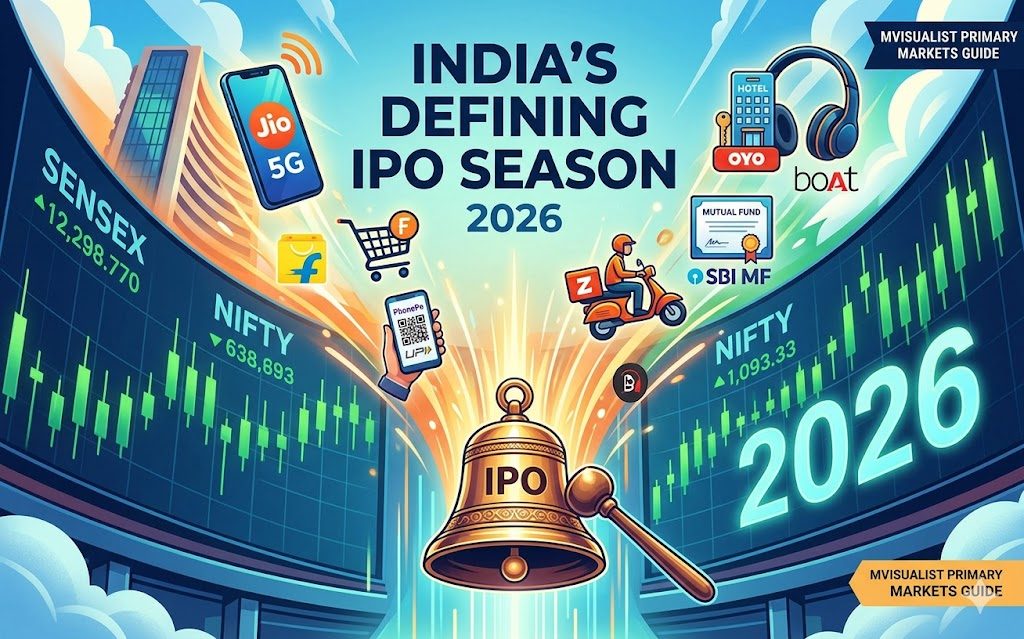
India’s Defining
IPO Season
From Reliance Jio’s potential record-breaking debut to Flipkart’s long-awaited homecoming listing, 2026 is shaping up to be the most consequential year in India’s primary market history. Here is your essential guide to the mainboard IPOs every investor should be tracking.
India’s IPO market has been on an extraordinary run. The primary market recorded over 100 mainboard IPOs in 2025, raising a record ₹1.75 lakh crore — yet the coming months threaten to eclipse that milestone entirely. The pipeline is not just bigger; it is qualitatively different. The names queuing at SEBI’s door this year are not regional lenders or mid-cap manufacturers. They are companies that have redefined how Indians communicate, shop, pay, and travel. Listing any one of them would be a landmark event. Listing all of them in the same calendar year would be genuinely historic.
Below, we profile the seven most consequential mainboard IPOs expected on the BSE and NSE in 2026, drawing on the latest regulatory filings, analyst estimates, and market intelligence. All valuations and timelines are indicative and subject to SEBI approvals and market conditions.
No IPO in 2026 — perhaps in the history of Indian capital markets — carries the anticipation of Jio Platforms. The telecom and digital services arm of Reliance Industries commands over 500 million subscribers and the largest revenue market share in India’s mobile industry, ahead of listed rival Bharti Airtel. Investment bankers have estimated Jio’s valuation at between $130 billion and $170 billion, with Jefferies previously floating figures as high as $180 billion. At a 2.5% public float — enabled by a revised SEBI rule for companies valued above ₹5 lakh crore — the IPO size could approach $4.5 billion, potentially making it the largest public offering in Indian history, surpassing Hyundai Motor India’s 2024 listing.
The timeline has shifted. Originally targeting H1 2026, the listing has been pushed back, primarily due to regulatory hurdles around final government notification of revised IPO norms. Mukesh Ambani told shareholders that “preparations are advancing steadily,” but no definitive open date has been announced. Most current estimates now point to H2 FY2026–27. Once it does arrive, the listing is expected to be a combination of fresh issue and offer-for-sale by existing investors including KKR, Silver Lake, and General Atlantic.
Flipkart’s IPO story is one of the longest-running in Indian corporate history. Founded in 2007 by Sachin Bansal and Binny Bansal, Walmart acquired a majority stake in 2018, and listing discussions have circulated ever since. The key structural barrier — Flipkart’s Singapore domicile — was resolved in March 2026 when the company completed its re-domiciliation to India following NCLT approval in December 2025. Flipkart Internet Pvt. Ltd. is now the primary holding and operating entity for the group’s Indian businesses, including Myntra, Ekart, and Cleartrip.
The company has initiated early discussions with investment banks including Goldman Sachs, and is expected to file its DRHP with SEBI in the coming months, with a listing window of late 2026 to early 2027. Indicative valuations range from $40 billion to $70 billion at the upper end, though the actual pricing will depend heavily on market conditions and investor appetite. The IPO is expected to be a combination of fresh issue and offer-for-sale. Flipkart’s quick-commerce arm, Flipkart Minutes, is already targeting over 1,500 dark stores by end-2026, underscoring its ambitions beyond core e-commerce.
PhonePe holds a commanding 40% market share in UPI transactions, making it the undisputed leader in India’s digital payments ecosystem. Beyond payments, the company has been aggressively expanding into credit, insurance, and wealth management — diversifying its revenue streams ahead of what would be a landmark fintech listing. PhonePe has already received SEBI’s approval to raise funds via IPO, with an updated DRHP expected imminently.
The IPO is expected to be structured largely as an Offer for Sale by existing shareholders, with reports pegging a listing valuation of around $15 billion. At an issue size of $1.2–1.5 billion, a successful PhonePe debut would mark a turning point for India’s fintech landscape — transforming nearly a decade of digital payments growth into a directly investable listed theme. For retail investors, it represents perhaps the purest play on India’s UPI revolution.
Quick-commerce unicorn Zepto has secured shareholder approval to raise up to ₹11,000 crore through its IPO, targeting a listing window between July and September 2026. The company commands a 23–27% share of India’s hypercompetitive quick-commerce market, backed by investors including Glade Brook and CalPERS. Its FY2025 revenue reportedly topped ₹11,000 crore — a figure that reflects hyper-growth and improving unit economics as the sector matures.
If successful, Zepto’s listing would make it one of India’s youngest startups to execute a mega IPO, and the first pure-play 10-minute delivery company to go public. The funds raised are expected to expand its delivery and warehouse network across tier-2 and tier-3 cities, strengthening its position against rivals Blinkit and Swiggy Instamart.
SBI Mutual Fund is India’s largest asset manager by AUM, and its proposed listing is a structurally significant event for a market that has seen peers like ICICI Prudential AMC and HDFC AMC generate enormous investor returns since their own debuts. The fund house is planning to offer up to 10% of its equity, targeting a raise of approximately $1.2 billion, giving public market investors direct exposure to India’s booming mutual fund industry — one fuelled by a generational shift from physical savings to financial assets.
An SBI Mutual Fund listing would be a landmark, much like the NSE’s long-awaited IPO: a chance to own a share of the infrastructure that underpins India’s investment ecosystem itself.
OYO’s IPO journey has been one of India’s most dramatic corporate sagas — a story of breakneck expansion, public setbacks, and a determined reinvention. The hospitality tech company, founded by Ritesh Agarwal in 2013, has reportedly filed a confidential DRHP with SEBI, a route that allows companies to gauge investor sentiment without prematurely disclosing sensitive financial data. Shareholders have already approved a fresh issue of up to ₹6,650 crore.
The final IPO date depends on regulatory approvals and market conditions. A successful OYO listing would be a redemption arc for India’s new-economy IPO narrative, validating the idea that loss-making startups can restructure, find profitability pathways, and earn a place on Dalal Street.
Imagine Marketing — the parent company behind boAt, India’s homegrown consumer electronics and audio brand — has filed an updated DRHP with SEBI for a ₹1,500 crore IPO. The offering comprises a ₹500 crore fresh issue and a ₹1,000 crore offer-for-sale by existing shareholders. boAt has carved out a dominant position in the affordable hearables and wearables segment, becoming a household name in India before setting its sights on international expansion.
The boAt IPO carries particular resonance for a new generation of Indian investors: it represents ownership in a brand they already wear, connecting consumer affinity with market participation in a way few listings can claim.
“India’s IPO pipeline for 2026 is the most consequential in the market’s history — spanning fintech, energy, healthcare, food, and infrastructure.”
Business Upturn, May 2026Taken together, these seven offerings represent a once-in-a-generation opportunity to invest in the companies that built modern India’s digital infrastructure. But they also carry the complexity that comes with any high-profile primary market event: headline valuations that require scrutiny, timelines that shift on regulatory winds, and the ever-present tension between institutional price discovery and retail enthusiasm.
Investors would do well to read the DRHPs carefully once filed — particularly the risk factors sections, revenue composition disclosures, and related-party transaction notes. Profitability trajectories, post-listing lock-in periods for promoters, and the proportion of OFS versus fresh issue are especially worth examining. An OFS-heavy structure means existing shareholders are cashing out, not that the company itself is raising capital for growth.
India’s broader macroeconomic backdrop remains supportive: domestic institutional investor inflows are healthy, retail participation in equities has deepened, and SEBI’s regulatory modernisation has improved transparency. 2025 was hailed as India’s “IPO renaissance.” 2026 may well be remembered as its defining chapter.
Stay Updated with mvisualist
We track India’s primary markets, data visualisations, and investment themes so you don’t have to chase the noise. Bookmark our IPO Watch section for DRHP alerts, subscription data, and GMP analysis as these listings approach.