☀ Morning Brief
MON · 18 MAY 2026 · ISSUE #50
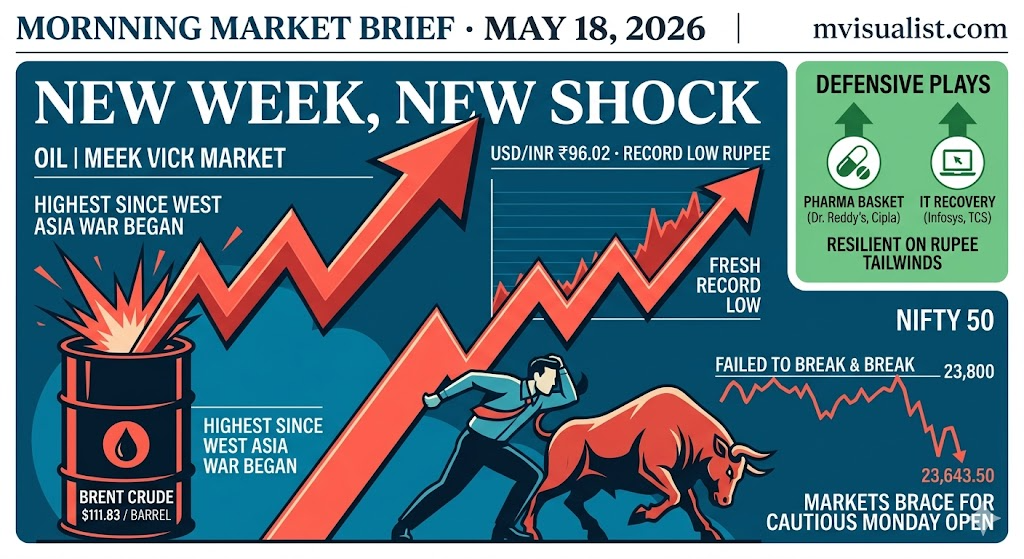
🛢️ CRUDE SHOCK: Brent surges to $111.83/barrel — highest since West Asia war began
₹96.02/USD — Record Low Rupee
Petrol: ₹106.68/L — Price Hike Confirmed
New Week, New Shock:
Crude at $111, Rupee at Record Low
— Markets Brace for a Cautious Monday
Last week’s tentative two-day recovery was erased on Friday. The new week opens with Brent crude surging to $111.83, the rupee crashing through ₹96, petrol prices hiked to ₹106.68, and the Nifty failing to hold above 23,800. The question is no longer “can markets recover?” — it’s “how far can they hold?”
Nifty Fri High
23,839
Touched but not held
Nifty Week Return
+264 pts
From 23,379 low
Brent (Mon vs Thu)
$111.83
▲ from $105.76
Rupee Crash
₹96.02
New record low
Petrol (Mon)
₹106.68/L
▲ Price hike done
Diesel (Mon)
₹93.14/L
▲ Elevated
23,800 Held?
❌ No
Failed on weekly close
Infra Data (Apr)
May 20
Key domestic event
Brent Crude
$111.83
▲ Multi-week high
Pre-war level was ~$90
WTI Crude (reference)
~$107
▲ Above $100
US inventory + Iran supply risk
India Petrol (Mon)
₹106.68
Price hike enacted
Diesel ₹93.14; LPG ₹912.50
Brent Hits $111.83 — The Highest Since the West Asia War Began. India’s Macro Picture Gets Harder.
The Monday morning headlines are dominated by a single, uncomfortable number: Brent crude at $111.83 per barrel — the highest it has traded since the Iran-US war-related disruption to the Strait of Hormuz began. This is a $21.83 premium above the pre-war baseline of ~$90 that India was paying as recently as late April. For context, every $10 rise in Brent crude adds approximately ₹8–10 lakh crore annually to India’s import bill. At $111, the math is brutal: India is paying an additional ₹17–22 lakh crore per year compared to the pre-war period — a structural drain on the current account, the rupee, and corporate margins. The petrol price hike to ₹106.68 per litre (confirmed Monday) and diesel at ₹93.14 reflect the government’s decision that oil marketing companies can no longer absorb under-recoveries at these levels. The rupee at ₹96.02 against the US dollar — a fresh record low — compounds the pressure: India pays for crude in dollars, so a weaker rupee makes every barrel even more expensive in local currency terms. The Saudi Aramco CEO has warned that Strait of Hormuz disruption may not normalise until 2027. That is the macro ceiling of this problem. Markets cannot sustainably recover until crude retreats meaningfully — and that requires a geopolitical breakthrough that shows no signs of arriving.
Stories Shaping Monday’s Open
Last Week · Friday Wrap
Nifty Touched 23,839 Intraday But Failed to Close Above 23,800 — Bearish Weekly Candle Formed
Friday’s session (May 15) carried the seeds of hope — the Nifty briefly touched 23,839.30 intraday, just shy of the 23,800 weekly close that analysts had identified as the recovery confirmation level. But profit booking in the second half erased those gains, and the index closed at 23,643.50 — a modest −46.10 points (−0.19%) decline. The critical technical outcome: Nifty formed a bearish weekly candlestick with a lower high and a lower low relative to the previous week. This pattern indicates that the corrective bias is still intact. The bearish candle means the 23,800–24,000 zone, which was once support, has now become resistance. The market’s two-day recovery was tactical and temporary — not structural. IT stocks offered a bright spot on Friday (Infosys +1.92%, Tech Mahindra +1.79%, Wipro +1.06%), finally responding to Nasdaq’s all-time record high. Dr. Reddy’s bounced 3.04% — recovering sharply from the previous week’s 86% PAT shock. But metals and energy dragged: Hindalco −3.47%, Tata Steel −1.87%, Reliance −1.67%.
DateOpenCloseChangeNote
Mon May 11
76,014
76,015
▼ −1,314 pts
5-shock day; VIX surge
Tue May 12
75,303
74,608
▼ −712 pts
IT joins rout; Day 2
Wed May 13
23,362*
23,412
▲ +33 pts
Streak snapped; Doji
Thu May 14
23,530*
23,689
▲ +277 pts
Adani, Cipla, Airtel surge
Fri May 15
23,731*
23,643
▼ −46 pts
Profit-book; 23,839 high
*Nifty 50 levels for Wed-Fri. Sensex shown for Mon-Tue. Weekly net: Nifty recovered +264 pts from the 23,379 low.
Currency · Record Low
Rupee Crashes to ₹96.02 — The Worst Level in Indian Currency History
The Indian rupee opened the new week at ₹96.02 against the US dollar — a fresh all-time record low. This deepens the vicious cycle that has defined May 2026: higher crude prices → wider current account deficit → rupee weakness → even higher rupee cost of crude imports → further current account pressure. The rupee at ₹96 means that India’s crude import cost in rupee terms is approximately 23% more expensive than it was in January 2026 when the rupee was around ₹84–85. For FIIs, a weak rupee erodes dollar-denominated returns on Indian equity investments — which is a key driver of continued foreign institutional selling. For domestic inflation, the weaker rupee raises the cost of all imported goods, not just crude, feeding into broader CPI and reducing RBI’s ability to cut interest rates. The RBI is likely monitoring the ₹96 level closely — any intervention signal from the central bank would be a short-term positive for the currency and markets.
IT Sector · Recovery Signal
IT Finally Bounced on Friday — Can the Momentum Continue Monday?
After four sessions of refusing to respond to Nasdaq’s all-time highs, Nifty IT finally delivered its overdue bounce on Friday: Infosys +1.92%, Tech Mahindra +1.79%, Wipro +1.06%, Dr. Reddy’s (pharma but export-driven) +3.04%. The catalyst was a combination of the US-India trade deal momentum (tariffs from 50% to 18%), the Nasdaq record close of 26,402, and extreme oversold RSI readings that had built up over a week of selling. The question for Monday: can the IT recovery extend into the new week, or does it get overwhelmed by macro headwinds — a stronger dollar (DXY at 98+), a weaker rupee (which paradoxically helps IT revenue in rupee terms but signals risk-off), and continued FII outflows? The consensus view: IT is the sector to buy on dips in this environment because it is a direct beneficiary of rupee depreciation (revenue earned in USD, costs in INR) and the US-India trade deal. Infosys, TCS, and HCL Tech remain the institutional favourites. Monday’s IT open will set the tone for whether last week’s bounce was noise or the start of a sector rotation trade.
Sector · Defensive Play
Pharma Stocks in Focus Monday — The One Sector That Benefits from Both Rupee Weakness and Crude Insulation
In a market environment dominated by crude-related macro stress, pharma remains the standout defensive sector for Monday, according to Goodreturns and multiple brokerages. The rationale is two-fold: (1) India’s pharma companies are large exporters to the US and Europe, earning revenues in foreign currency — which means rupee depreciation directly boosts their INR revenue without a corresponding cost increase; and (2) pharma companies have minimal crude oil input cost exposure compared to energy, materials, or consumer goods companies. Vipul Bhowar of Waterfield Advisors has explicitly recommended investors “pivot towards export-heavy sectors like Pharma, which stand to benefit from a depreciating Rupee.” Dr. Reddy’s (+3.04% Friday recovery), Cipla (still +8%+ from its Thursday surprise), and Sun Pharma (defensive anchor) are the three names to watch for continued institutional accumulation.
💊 Pharma — Monday’s Defensive Basket
Sun Pharma
Sector anchor; domestic + US export mix; least volatile in risk-off
Dr. Reddy’s
3.04% recovery Friday after 86% PAT shock; oversold bounce candidate
Cipla
+8.09% Thu on BTF trade; US business $780M annual run-rate; sector momentum
Divi’s Labs
API exporter; full rupee tailwind; minimal crude exposure
Aurobindo Pharma
High US revenue share; US-India tariff deal positive; oversold
Zydus Life.
US acquisition reportedly nearing; potential re-rating catalyst this week
Geopolitics · Iran · Crude Driver
US-Iran Ceasefire Remains Fragile — Uranium Enrichment Warning Intensifies the Risk Premium
The US Energy Secretary’s warning last week that Iran may be weeks away from weapons-grade uranium enrichment has added a new dimension to the West Asia crisis — one that pushes the Iran risk from a ceasefire breakdown to an outright nuclear escalation scenario. Markets are now pricing not just the war premium but a potential regime-change premium in crude. The Strait of Hormuz — through which approximately 20% of global traded oil passes — remains near-shutdown for most traffic, contributing to the Brent surge to $111.83. India is watching the expiry of US sanctions waivers on Russian oil — another supply-side variable that could further tighten global crude availability. The government’s 60-day strategic crude reserve (confirmed by Petroleum Minister Puri) provides operational comfort, but does nothing to relieve financial pressure on oil marketing companies facing escalating under-recoveries even after Monday’s fuel price hike.
Strategy · Market Debate
“Sell in May and Go Away” — The Debate That Defines India’s Current Investment Moment
The old market adage — “Sell in May and go away” — is being debated with unusual urgency by Indian fund managers this week. With Nifty down approximately 2.8% month-to-date and every macro variable (crude, rupee, FII flows) pointing in the wrong direction, the “sell” camp has real arguments. But the countercase from HDFC Securities is compelling: “Investors should not blindly ‘sell in May and go away’ in Indian markets right now. The more sensible view is to stay selectively invested, because the recent correction has already taken some heat out of valuations.” The key data point: Nifty FY27 EPS estimate stands at ₹1,232 — down just 1.6% since March 30, 2026, with implied earnings growth of ~13% for the year. At current Nifty levels of ~23,650, the market is trading near long-term average PE multiples. Vipul Bhowar of Waterfield Advisors put it simply: “Completely exiting the market would mean risking a significant miss on a potential relief rally should there be even a minor de-escalation or a reopening of the Strait of Hormuz.” The “Sell in May” case fails because the catalyst for a sharp reversal — any ceasefire signal — is a single headline away.
This Week · Data Calendar
Infrastructure Output Data (April 2026) Due May 20 — The Domestic Growth Signal Markets Need
Amid the macro noise of crude and rupee, India’s core sector/infrastructure output data for April 2026 is scheduled for release on May 20 (Wednesday) — a release that Ajit Mishra of Religare Broking has specifically flagged as a key domestic catalyst for the week. The eight core sectors — coal, crude oil, natural gas, refinery products, fertilisers, steel, cement, and electricity — collectively have a 40.27% weight in India’s Index of Industrial Production. A strong print would provide evidence that India’s domestic growth engine is resilient despite the macro headwinds, supporting the “stay invested selectively” camp. A weak print would add to the bearish case. Also watch: Q4 FY26 earnings results continue to trickle in this week for mid-cap and small-cap companies. The final phase of the earnings season will provide stock-specific opportunities for disciplined investors even in a weak macro environment.
Top 3 Risks Heading Into This Week
Crude at $111.83 — Further Spike Risk
Any Iran-US ceasefire breakdown, nuclear escalation, or Strait of Hormuz incident could push crude above $115–120. This is India’s #1 macro risk this week.
Rupee at ₹96 — Intervention or Freefall?
Record-low rupee amplifies crude costs, deters FII flows, and fuels inflation. Watch for RBI intervention — any signal would be a sharp positive catalyst for markets.
FII Outflows — Pace a Key Signal
May’s FII selling pace (~₹24,000+ Cr MTD) is on track to be 2026’s worst month. A reversal to net buying is the single largest re-rating catalyst available.
Stocks to Watch · Monday May 18
01
Defensive
Sun Pharma / Cipla / Dr. Reddy’s — Pharma Basket
With Brent at $111.83 and the rupee at ₹96, pharma is the only Nifty 50 sector that benefits from currency weakness (USD revenue), is insulated from crude input costs, and has been explicitly recommended by Waterfield Advisors, Goodreturns, and BusinessToday for Monday. Pharma is the week’s defensive anchor — build positions on any Monday morning dip.
02
Momentum Continuation
Infosys / TCS / Tech Mahindra — IT Recovery Trade
After four sessions of ignoring Nasdaq’s record highs, IT finally bounced Friday (+1.92% Infosys, +1.79% TechM, +1.06% Wipro). Monday is the test: can IT sustain its recovery? A weaker rupee (₹96) directly boosts IT earnings in INR. The US-India 18% tariff deal is a structural medium-term positive. Treat any Monday pullback in IT as a buying opportunity with a tight stop below Friday’s lows.
03
Crude Beneficiary
ONGC / Oil India — Upstream Windfall
Brent at $111.83 is the highest upstream realisation level ONGC has seen since the war began. Every $10/barrel above breakeven adds thousands of crores in additional quarterly revenue. ONGC is the clearest structural beneficiary of elevated crude in the Nifty 50. Watch for strong institutional buying as fund managers rotate into energy upstream to offset OMC pressure.
04
Avoid / Reduce
IndiGo (InterGlobe Aviation) — Crude’s Direct Casualty
Aviation fuel (ATF) is directly linked to crude prices. With Brent at $111.83 — up from $90 pre-war — IndiGo’s fuel cost per seat-kilometre has surged dramatically. The company has limited ability to pass all costs to consumers given competitive pricing dynamics. Monday is the worst macro environment for aviation stocks this year. Reduce or avoid fresh longs.
05
Watch Closely
HDFC Bank / ICICI Bank — Private Banks at Support
Kotak Bank (+1.38%) and ICICI Bank (+0.15%) showed relative resilience on Friday. Private banks are oversold and near technical support zones. Any RBI intervention to defend the rupee could trigger a positive sentiment shift for rate-sensitive financials. Watch the Bank Nifty 53,000–53,100 support zone Monday — a bounce here extends the recovery case.
“Going ahead, failure to move above the breakdown area of 23,800–24,000 will keep the bias corrective and can lead to testing of the support area of 23,200–23,000. While a move above the breakdown area will signal a pause in the downtrend and open a pullback towards 24,500–24,600 levels — the high of April 2026.”
Ajit Mishra · SVP Research · Religare Broking · May 16, 2026
“Investors should not blindly ‘sell in May and go away’ in Indian markets right now. The more sensible view is to stay selectively invested, because the recent correction has already taken some heat out of valuations, and earnings growth is likely to improve from here. Trim exposure to heavy crude consumers and pivot towards export-heavy sectors like Pharma.”
Vipul Bhowar · Senior Director & Head of Equities · Waterfield Advisors
Monday’s Key Technical Levels
IndexSupport ZonesResistance Zones
Nifty 50
23,500–23,400 — near-term support
23,200–23,150 — critical floor (Mishra)
23,000–22,900 — next major support
23,200–23,150 — critical floor (Mishra)
23,000–22,900 — next major support
23,800–24,000 — now resistance (breakdown zone)
24,500–24,600 — target if 24K reclaimed
Weekly bearish candle = corrective bias
24,500–24,600 — target if 24K reclaimed
Weekly bearish candle = corrective bias
Sensex
74,500–74,200 — key support band
74,000 — critical floor to hold
74,000 — critical floor to hold
75,600–76,000 — immediate resistance
Bullish reversal requires decisive break above 76,000
Bullish reversal requires decisive break above 76,000
Bank Nifty
53,000–53,100 — immediate support
52,500 — next floor if 53K breaks
52,500 — next floor if 53K breaks
54,100–54,200 — first resistance
55,000+ — recovery confirmation zone
55,000+ — recovery confirmation zone
India VIX
Watch for easing below 16 — signal that fear is dissipating and a more sustained recovery is beginning
Currently elevated. Crude at $111.83 and rupee at ₹96 keep VIX structurally elevated until macro resolves
mvisualist · Monday Morning Verdict · Issue #50
The Market Didn’t Break — But $111 Crude and ₹96 Rupee Are Now the Wall
Monday, May 18 opens with the most challenging macro combination of the year: crude at $111.83 (the highest since the West Asia war began), the rupee at a record-low ₹96.02, petrol hikes enacted at ₹106.68, and a bearish weekly Nifty candle that failed to sustain the 23,800 recovery target. The cautious market opening expected today reflects these twin macro headwinds rather than any sudden deterioration in domestic fundamentals — India’s FY27 EPS trajectory remains intact at ~13% growth, and the US-India trade deal at 18% tariffs is still a structural positive that the market hasn’t fully priced. But markets cannot sustainably rally into $111 crude. The strategy for this week is clear: stay selectively invested rather than panic-selling, concentrate in pharma and IT (the two sectors that benefit from rupee weakness and are insulated from crude), reduce or exit heavy crude consumers (aviation, OMCs, paints, chemicals), and monitor three catalysts closely — any US-Iran de-escalation signal, any RBI currency intervention to defend ₹96, and Wednesday’s April infrastructure output data. Hold 23,200–23,150 as your positional stop loss. Below that level, the next significant support is at 23,000–22,900 — a zone that would represent a test of longer-term demand. Above 23,800 on a closing basis, the recovery narrative reopens. The market is in a holding pattern — not broken, but not healed.
🛢️ Crude $111.83 — Week’s Anchor Risk
💱 Rupee ₹96 — Record Low
💊 Pharma — Monday’s Defensive Play
🖥️ IT — Rupee Tailwind Continues
📊 Infra Data Apr 26 — May 20
🏛️ RBI Intervention — Key Watch
Key Events This Week
Today
Crude at $111.83 — market opens cautious; pharma and IT in focus Priority
Today
Rupee at ₹96.02 — watch for RBI intervention signal at record lows Forex
Today
Q4 FY26 mid-cap/small-cap results continuing — stock-specific opportunities amid macro noise
Wed 20
India Infra Output Data (April 2026) — key domestic growth signal Data
Ongoing
US-Iran ceasefire status — Iran uranium enrichment warning active; any escalation = crude spike above $115
Ongoing
Russian oil sanctions waiver — expiry watch; supply-side crude risk variable
Ongoing
US-India trade deal (18% tariff) — watch for implementation details and IT/pharma upgrade cycle
3:30 PM
Daily FII/DII flows — reversal to net FII buying is the week’s most important structural signal
Commodities & Prices · Monday
🛢️ Brent Crude$111.83▲ Multi-week high
💱 USD / INR₹96.02Record low
⛽ Petrol (Delhi)₹106.68▲ Hiked Monday
🚗 Diesel (Delhi)₹93.14▲ Elevated
🏠 LPG₹912.50Steady
🥇 Gold (22K)₹14,384/gmElevated
🪙 Silver₹2,79,900/kgStrong
Institutional Flows · Last Known
FII (May 14)−₹4,703 Cr
DII (May 14)+₹5,869 Cr
FII MTD (May)~−₹24,000+ Cr
DII MTD (May)~+₹33,000+ Cr
📌 DII absorption has exceeded FII selling all month — preventing a market collapse. A reversal to net FII buying remains the single most important structural signal for a sustained recovery. At crude $111.83, FII flows are unlikely to reverse until geopolitical clarity improves.
Global Markets · Reference
🇺🇸 Nasdaq (last)26,402All-Time High
🇺🇸 S&P 5007,444Near record
🇺🇸 Dow Jones49,693Mixed
🇺🇸 DXY98.46Firm headwind
🛢️ Brent vs S&PDivergenceUS up, India down
🟡 Gold Spot$4,699/ozSafe haven bid
Key Levels · Monday
Nifty Resistance23,800–24,000
Nifty Support 123,500–23,400
Nifty Support 223,200–23,150
Nifty Floor23,000–22,900
Sensex Support74,500–74,200
Sensex Resist.75,600–76,000
Bank Nifty Supp.53,000–53,100
Bank Nifty Resist.54,100–55,000