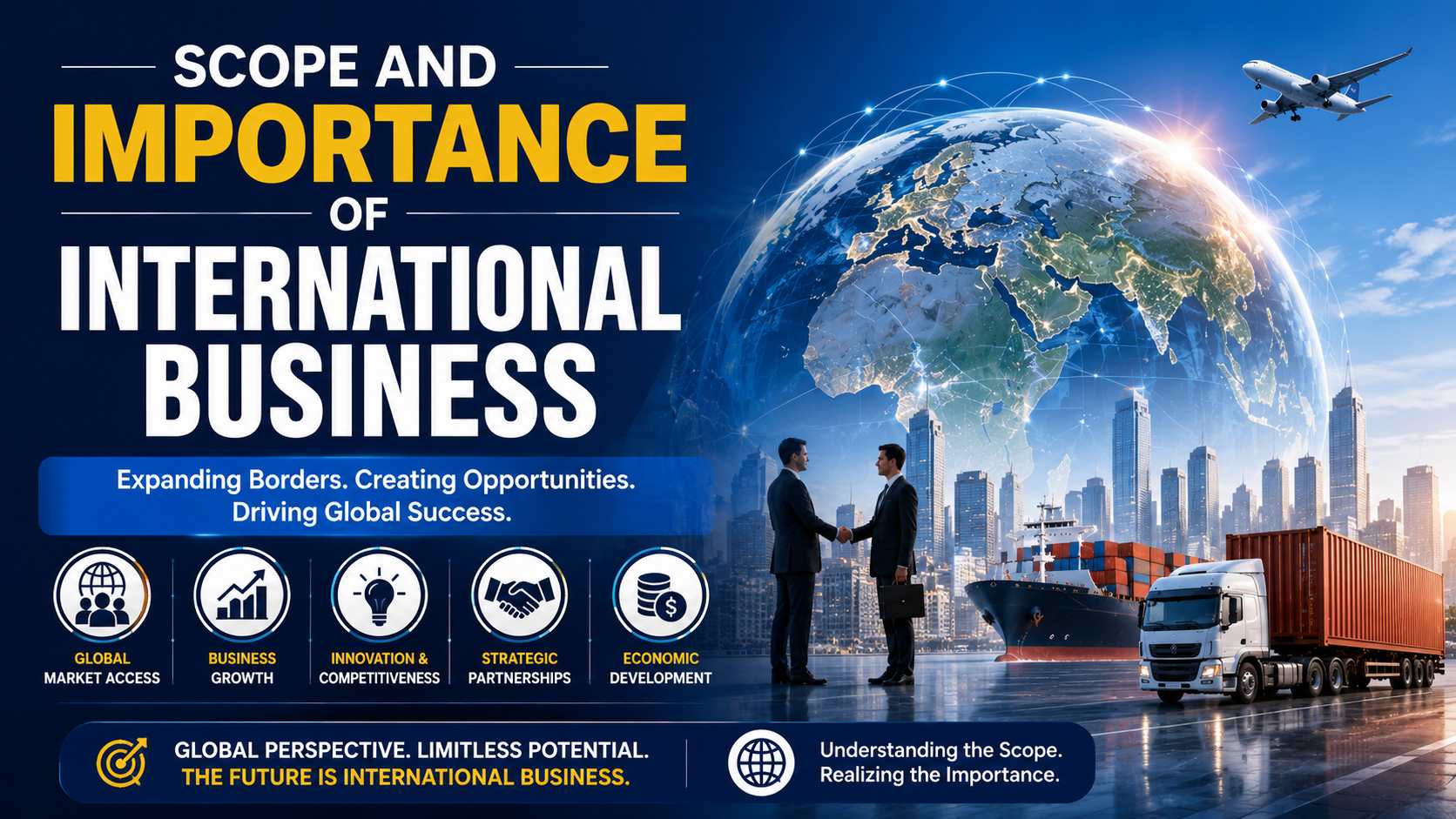
Scope and Importance of International Business
A complete, exam-ready lecture for B.Com, M.Com, BBA, MBA and UGC NET aspirants — explained simply, remembered easily.
01.Meaning of International Business
Imagine a shop owner in Ahmedabad who only sells to customers in his own street. Now imagine that same shop owner starts selling to customers in Mumbai, then Dubai, then London. The moment his business activities cross the boundary of his own country, he has entered the world of international business.
In simple words, when a business transaction has at least one party located outside the home country, it becomes an international business transaction. This can happen through trade (exporting and importing), investment (setting up a factory abroad), licensing a brand name to a foreign company, or even outsourcing customer service to another country.
02.Domestic Business vs International Business
Before going deeper, students must clearly understand how international business is different from the business we see around us every day. This comparison is a favourite for short-answer and MCQ questions.
| Basis | Domestic Business | International Business |
|---|---|---|
| Area of operation | Within one country | Across two or more countries |
| Currency used | Single (home) currency | Multiple currencies, exposed to exchange rate risk |
| Customers | Homogeneous, known culture | Heterogeneous, diverse cultures and languages |
| Government regulations | One set of laws | Laws of home country + host country + international treaties (e.g., WTO rules) |
| Competition | Local and national competitors | Global competitors, often very large MNCs |
| Risk level | Lower, more predictable | Higher — political, currency, and cultural risks |
| Resource mobility | Free movement within the country | Restricted by visas, tariffs, capital controls |
03.Nature and Features of International Business
These features explain “what kind of activity” international business really is. UGC NET often asks “which of the following is NOT a feature” type questions, so read each point carefully.
- Large scale of operations: International business usually deals in large volumes because it serves many countries, not just one local market.
- Integration of economies: It connects the economies of different countries through trade, investment, and technology transfer.
- Dominance of MNCs: Large Multinational Corporations (MNCs) like Apple, Toyota, Unilever, and Tata play a major role in driving international business.
- Benefits to both nations: It is designed to benefit both the home country (where the company originates) and the host country (where it operates).
- Sensitivity to external environment: It is highly influenced by political stability, exchange rates, international laws, and global events.
- Keen competition: Firms compete with the best companies of the world, not just local rivals, so quality and innovation matter more.
- Market segmentation: Businesses must adapt to different consumer tastes, climates, and cultures in each country — what sells in India may need changes to sell in Japan.
04.Scope of International Business
“Scope” simply means — what all activities does international business cover? Think of it as the full menu of ways a company can engage with the world. This is one of the most repeated topics in UGC NET, so understand each item with a real-life example.
1. Merchandise Exports and Imports
Buying and selling of physical, tangible goods across borders — e.g., India exporting textiles, importing crude oil.
2. Service Exports and Imports
Trade in intangible services like banking, tourism, IT, education, and consultancy — e.g., India’s IT/BPO exports to the USA.
3. Foreign Direct Investment (FDI)
A company directly setting up or buying operations in another country — e.g., Suzuki manufacturing cars in India.
4. Foreign Portfolio Investment (FPI)
Investing in shares, bonds, and securities of another country without controlling the business — e.g., a US fund buying Indian stocks.
5. Licensing and Franchising
Allowing a foreign firm to use your brand, technology, or process for a fee — e.g., McDonald’s franchise outlets worldwide.
6. Contract Manufacturing & Outsourcing
Getting goods or services produced by another firm in a different country — e.g., Apple’s contract manufacturing in China.
7. Turnkey Projects
Building a complete project (like a power plant) abroad and handing it over ready-to-operate to the client.
8. Management Contracts
A firm manages the operations of a foreign company for an agreed fee, without ownership — common in hotel chains.
05.Importance of International Business
Why does international business matter — to a country, and to a company? This question is asked almost every year in some form, so let’s split it cleanly into two angles.
A. Importance to a Nation (Country-Level Benefits)
- Earns foreign exchange: Exports bring in foreign currency, which helps pay for essential imports like oil and machinery.
- Optimum utilisation of resources: Countries can specialise in producing what they are best at and trade for the rest (based on the theory of comparative advantage).
- Generates employment: Export-oriented industries and foreign companies setting up units create new jobs.
- Transfer of technology: Foreign collaborations bring modern machinery, skills, and management practices into the host country.
- Improves standard of living: Wider variety of goods, better quality products, and competitive prices benefit consumers.
- Strengthens international relations: Trade ties often translate into stronger diplomatic and political relationships between nations.
- Balanced economic growth: Encourages industrial development, infrastructure building, and integration with the world economy.
B. Importance to a Business Firm (Company-Level Benefits)
- Larger market and higher sales: A company is no longer limited to one country’s demand; it can sell to billions of customers worldwide.
- Higher profitability: Economies of scale from large production runs can reduce per-unit cost and raise profit margins.
- Spreading risk: If one country’s market slows down, sales in another country can balance overall performance.
- Access to cheaper resources: Firms can source raw material, labour, or capital from wherever it is most cost-effective.
- Competitive advantage and brand image: Operating globally builds a stronger brand reputation and pushes firms to innovate continuously.
- Extended product life cycle: A product that has become “old” in one market may still be in high demand in another, developing market.
06.Stages of Internationalisation
A firm usually does not become global overnight. It passes through stages, each showing a deeper level of international involvement.
| Stage | What Happens |
|---|---|
| 1. Domestic Stage | Company sells only in its home country; no international activity yet. |
| 2. International Stage | Company starts exporting; home country still remains the main focus. |
| 3. Multinational Stage | Company sets up operations/subsidiaries in several countries, adapting products to local needs. |
| 4. Global Stage | Company treats the whole world as one integrated market with a standardised strategy. |
| 5. Transnational Stage | Highest stage — company combines global efficiency with local responsiveness, with decision-making spread across countries rather than centralised at headquarters. |
07.Modes of Entry into International Business
This overlaps with “scope” but is asked separately too — focus on how a firm actually enters a foreign market.
- Exporting: Simplest and lowest-risk mode — selling goods produced at home to foreign buyers.
- Licensing: Granting a foreign firm the right to use your patent, trademark, or technology for a royalty.
- Franchising: A more complete package than licensing — the franchisor provides the brand, systems, and ongoing support (common in fast food and retail).
- Joint Ventures: Two companies from different countries jointly own and operate a new business, sharing risk and expertise.
- Foreign Direct Investment (Wholly Owned Subsidiary): The company sets up and owns its own manufacturing or service unit abroad.
- Strategic Alliance: Firms cooperate on a specific project (like R&D or distribution) without merging or losing independence.
08.The 5 Ps of International Business
A handy framework often quoted in UGC NET notes to describe the key elements a firm must manage internationally:
- Product: What is offered, and how it may need to be adapted for different markets.
- Price: Pricing strategy considering currency, tariffs, and local purchasing power.
- Place: Distribution channels and logistics across borders.
- Promotion: Advertising and communication adapted to local language and culture.
- People: Managing a diverse, multicultural workforce and customer base.
09.Benefits and Limitations at a Glance
Key Benefits
Bigger markets, better resource use, technology transfer, employment generation, improved living standards, stronger global relations, and growth opportunities for firms.
Key Challenges
Political and currency risk, cultural differences, complex legal compliance across countries, trade barriers (tariffs and quotas), and intense global competition.
10.Previous Year Questions (PYQ Style)
These are framed in the style of questions that have actually appeared in UGC NET Commerce and university exams on this topic.
11.Multiple Choice Questions (MCQs)
- (a) Business activity confined to one country
- (b) Business activity involving transactions across two or more countries
- (c) Government-only trade between two nations
- (d) Business done only through the internet
Show Answer
- (a) Wholly owned subsidiary
- (b) Joint venture
- (c) Exporting
- (d) Foreign direct investment
Show Answer
- (a) Product
- (b) Price
- (c) Profit
- (d) People
Show Answer
- (a) Foreign Direct Investment (FDI)
- (b) Foreign Portfolio Investment (FPI)
- (c) Joint Venture
- (d) Licensing
Show Answer
- (a) Domestic stage
- (b) Multinational stage
- (c) Global stage
- (d) International stage
Show Answer
- (a) Contract manufacturing
- (b) Turnkey project
- (c) Franchising
- (d) Portfolio investment
Show Answer
- (a) Higher profit margins for the firm
- (b) Earning of foreign exchange
- (c) Extended product life cycle for a brand
- (d) Spreading business risk across markets
Show Answer
- (a) Management contract
- (b) Turnkey project
- (c) Licensing
- (d) Strategic alliance
Show Answer
12.Short Answer Questions (2–5 Marks)
- Define international business in your own words.
- State any four differences between domestic business and international business.
- What is meant by Foreign Direct Investment (FDI)? Give one example.
- Distinguish between licensing and franchising.
- Mention the five stages of internationalisation of a firm.
- Explain the 5 Ps of international business briefly.
- List any four reasons why countries engage in international trade.
- What is a turnkey project? Give an example.
- Differentiate between FDI and FPI.
- Why is international business considered riskier than domestic business?
13.Long Answer Questions (8–15 Marks)
- Explain the meaning, nature, and scope of international business with suitable examples.
- Discuss the importance of international business from the point of view of (a) a nation and (b) a business firm.
- Describe the various stages a firm passes through while internationalising its operations.
- Explain the different modes of entry available to a firm wishing to enter foreign markets. Which mode would you recommend for a small Indian manufacturing firm, and why?
- “International business benefits both the home country and the host country.” Discuss this statement with examples.
- Compare and contrast domestic business and international business on at least six different parameters.
- Critically examine the benefits and challenges (limitations) of international business in the present global economic environment.
Recommended for further reading and official verification:
UGC NET official syllabus and notifications — ugcnet.nta.ac.in
University Grants Commission — ugc.gov.in
Ministry of Commerce and Industry, Government of India (for trade policy and FDI data) — commerce.gov.in
World Trade Organization (for global trade rules) — wto.org