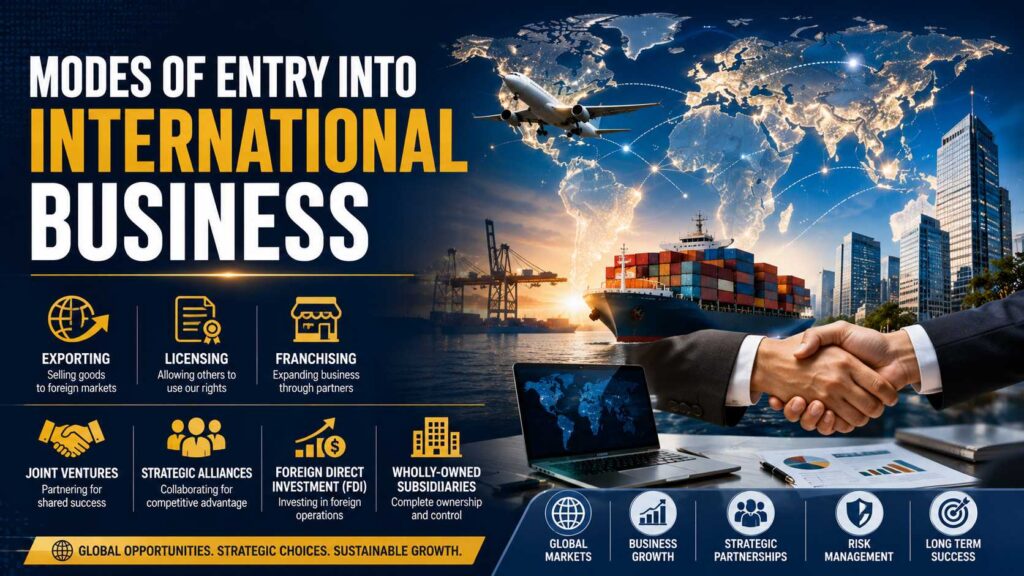
Modes of Entry into International Business
Every entry strategy explained simply, with real-life company examples, advantages, and disadvantages — for B.Com, M.Com, BBA, MBA and UGC NET Commerce aspirants.
01.Meaning — Why “Mode of Entry” Matters
Suppose a small bakery in Surat makes excellent cookies, and the owner now wants to sell them in Dubai. There are many ways she could do this. She could simply pack and ship cookies to a Dubai-based distributor (exporting). She could let a Dubai company use her recipe and brand name for a fee (licensing). She could partner with a local Dubai bakery and share ownership of a new joint outlet (joint venture). Or she could fly down, rent a shop, and open her own bakery branch in Dubai (foreign direct investment).
Each of these is a different “mode of entry” — a different route or strategy for stepping into a foreign market. The choice is never random; it depends on how much money she is willing to invest, how much risk she can tolerate, and how much control she wants over the brand.
02.The Risk–Control Ladder
Before learning each mode individually, see them all on one ladder. This single picture answers most “which mode has higher risk/control” exam questions instantly.
03.Modes of Entry (Detailed)
Exporting
The firm produces goods at home and simply sells them to buyers in a foreign country, either directly or through agents/distributors. It is the simplest and most common starting point for international business.
- Low investment and low risk
- Easy way to test a foreign market
- No need to understand deep local regulations
- High transportation and tariff costs
- Limited control over how the product is sold locally
- Vulnerable to import restrictions
Licensing
The firm (licensor) allows a foreign company (licensee) to use its patent, trademark, technology, or production process in exchange for a fee or royalty. The licensee produces and sells the product locally under the agreement.
- Minimal capital investment needed
- Quick market entry
- Avoids tariffs since goods are made locally
- Limited control over quality and brand image
- Risk of licensee becoming a future competitor
- Lower profit compared to owning operations
Franchising
A more complete package than licensing — the franchisor (parent company) provides its brand name, business model, training, and ongoing operational support to a local franchisee, who runs the outlet under strict guidelines.
- Rapid expansion with low capital from the franchisor
- Consistent global brand experience
- Local franchisee understands local customers
- Risk of brand damage if a franchisee underperforms
- Profit sharing reduces overall margins
- Difficult to maintain uniform quality everywhere
Turnkey Projects
A firm designs, builds, and sets up a complete facility or project in a foreign country, and then hands over full operational control to the foreign client once it is ready to run — “turn the key and start.”
- Earns income from technical expertise without long-term ownership
- Useful where foreign ownership of infrastructure is restricted
- One-time large contract value
- No long-term presence or recurring revenue in that market
- May train a future competitor through technology transfer
- High project execution risk
Joint Ventures (JV)
Two or more firms from different countries jointly create a new company, sharing ownership, control, profits, risks, and management responsibilities.
- Shared risk and investment between partners
- Access to local partner’s market knowledge and networks
- Easier entry where local ownership is legally required
- Possible conflicts over control and decision-making
- Profits must be shared between partners
- Cultural and management style differences can cause friction
Strategic Alliance
Two or more firms cooperate on a specific area — such as research, technology sharing, or distribution — without forming a new jointly-owned company and while remaining fully independent businesses.
- Flexible — no need to merge ownership
- Combines strengths of both partners (e.g., technology + distribution)
- Lower commitment than a joint venture
- Limited long-term control over the partnership’s direction
- Possible disagreement over shared resources or strategy
- Partner may gain knowledge and later compete independently
Foreign Direct Investment (FDI) — Wholly Owned Subsidiary
The firm sets up and fully owns its own operations abroad, either by building a completely new facility (Greenfield investment) or by buying an existing foreign company (acquisition). This gives the company complete control.
- Complete control over operations and brand
- Full claim on all profits earned
- Strong long-term commitment builds trust in host country
- Highest investment and financial risk
- Greater exposure to political and currency risk
- Slower to set up compared to other modes
04.Factors Affecting Choice of Entry Mode
UGC NET often asks “what should a firm consider before choosing a mode of entry” — these factors form a complete answer.
Level of Control Desired
A firm wanting full control over quality and brand will prefer FDI over licensing or franchising.
Financial Resources
Smaller firms with limited capital often start with exporting or licensing rather than setting up a subsidiary.
Risk Appetite
Firms cautious about political or currency risk may avoid heavy investment modes like wholly owned subsidiaries.
Government Regulations
Some countries require foreign firms to enter only through a joint venture with a local partner in certain sectors.
Nature of the Product/Service
Perishable goods may suit local production via FDI or JV rather than long-distance exporting.
Market Knowledge and Experience
Firms new to a country often partner locally (JV, franchising) to reduce the learning curve about culture and regulations.
05.Quick Comparison Table
| Mode | Investment Needed | Control | Risk | Typical Example |
|---|---|---|---|---|
| Exporting | Very Low | Low | Low | Textile exports to other countries |
| Licensing | Low | Low | Low–Moderate | Pharma formula licensed to local manufacturer |
| Franchising | Low (for franchisor) | Moderate | Moderate | McDonald’s, Domino’s outlets |
| Turnkey Projects | Moderate–High (short term) | Temporary, high during project | Moderate | Power plant construction abroad |
| Joint Venture | Moderate–High | Shared | Moderate–High | Maruti Suzuki (India–Japan) |
| Strategic Alliance | Low–Moderate | Shared, limited | Moderate | Airline codeshare partnerships |
| FDI / Wholly Owned Subsidiary | High | Full | High | Hyundai’s own plant in Chennai |
06.Previous Year Questions (PYQ Style)
These are framed in the style of questions that have appeared in UGC NET Commerce and university exams on this topic.
07.Multiple Choice Questions (MCQs)
- (a) Exporting
- (b) Licensing
- (c) Wholly owned subsidiary (FDI)
- (d) Strategic alliance
Show Answer
- (a) Franchising
- (b) Licensing
- (c) Turnkey project
- (d) Joint venture
Show Answer
- (a) Exporting
- (b) Turnkey project
- (c) Franchising
- (d) Foreign portfolio investment
Show Answer
- (a) Strategic alliance
- (b) Turnkey project
- (c) Licensing
- (d) Wholly owned subsidiary
Show Answer
- (a) A firm selling goods abroad without any local partner
- (b) Two firms from different countries jointly owning and managing a new company
- (c) A firm fully owning its foreign operations
- (d) A firm licensing its brand name only
Show Answer
- (a) Buying an existing company in a foreign country
- (b) Building a completely new facility from scratch in a foreign country
- (c) Licensing a brand name abroad
- (d) Forming a temporary alliance with another firm
Show Answer
- (a) Wholly owned subsidiary
- (b) Exporting only
- (c) Joint venture with a local partner
- (d) Turnkey project only
Show Answer
- (a) Joint venture
- (b) Strategic alliance
- (c) Wholly owned subsidiary
- (d) Licensing
Show Answer
08.Short Answer Questions (2–5 Marks)
- Define “mode of entry” into international business.
- State any four modes of entry into international business.
- Differentiate between licensing and franchising with one example each.
- What is a turnkey project? Give a real-life example.
- Explain the meaning of a joint venture with an example.
- Distinguish between a joint venture and a strategic alliance.
- What is the difference between a Greenfield investment and an acquisition?
- Why is exporting considered the lowest-risk mode of entry?
- State any three factors that influence a firm’s choice of entry mode.
- What is a wholly owned subsidiary? Give an example.
09.Long Answer Questions (8–15 Marks)
- Explain the various modes of entry into international business with their advantages, disadvantages, and suitable real-life examples.
- Discuss the factors that a company should consider before selecting a mode of entry into a foreign market.
- “There is a direct relationship between risk, control, and investment in choosing a mode of entry.” Explain this statement with reference to at least five entry modes.
- Compare and contrast licensing, franchising, and joint ventures as strategies for entering foreign markets.
- Critically examine the advantages and limitations of Foreign Direct Investment (FDI) as a mode of entry into international business.
- A small Indian manufacturing firm wants to expand into South-East Asian markets but has limited capital. Suggest and justify a suitable mode of entry, comparing it with at least two alternative modes.
- Discuss how the choice of entry mode differs for a service-based company versus a manufacturing-based company expanding internationally.
Recommended for further reading and official verification:
UGC NET official syllabus and notifications — ugcnet.nta.ac.in
University Grants Commission — ugc.gov.in
Department for Promotion of Industry and Internal Trade, Government of India (for FDI policy) — dpiit.gov.in
Ministry of Commerce and Industry, Government of India — commerce.gov.in