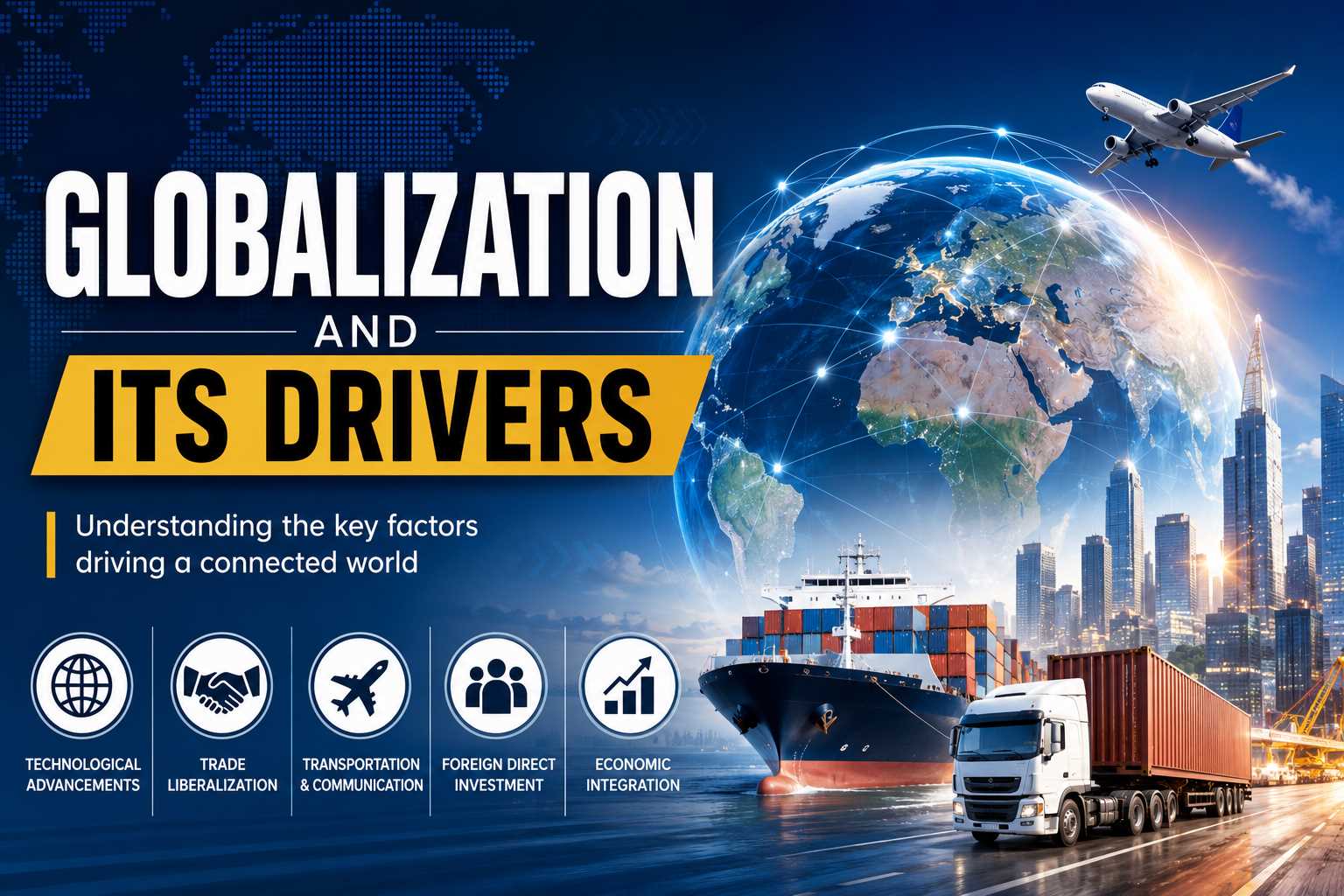
Globalization and Its Drivers
Explained in detail with simple, real-life examples — for B.Com, M.Com, BBA, MBA and UGC NET Commerce aspirants.
01.Meaning of Globalization
Think about your morning. You wake up, check a phone designed in California and assembled in Vietnam, eat cereal made from oats grown in Canada, wear a t-shirt stitched in Bangladesh, and watch a Korean drama on a streaming app before leaving for college. None of this felt unusual to you — and that is exactly what globalization has done to the world.
In simple words, globalization is the shrinking of the world. Distances still exist on the map, but in terms of business, money, and information, the world increasingly behaves like one large, connected marketplace rather than many separate, closed economies.
02.How Globalization Happens — A Simple Story
Before listing the drivers formally, picture this short story — it captures almost the entire concept:
A shoe company in Germany designs a new sports shoe (design and R&D stay in Germany). The rubber sole is manufactured in Thailand because rubber is cheap there. The fabric upper is stitched in Vietnam because labour costs are lower. The shoes are shipped using container ships tracked in real time through GPS and software. They are sold online through a website that accepts payments from anywhere in the world, and a customer in Ahmedabad orders a pair using a smartphone, pays through a digital wallet, and receives it within a week through an international courier network.
This single pair of shoes has already crossed four or five countries before reaching the customer’s feet — and this happened only because of specific forces that made such fast, low-cost, cross-border coordination possible. Those forces are exactly what we call the drivers of globalization.
03.The Drivers of Globalization (Detailed)
Each driver below is explained with the logic behind it and a real-life example, so that you understand the “why” and not just memorise a list.
Technological Advancement
Improvements in computing, the internet, mobile communication, and automation have made it possible to design, coordinate, and control business operations across multiple countries at very low cost and in real time.
Liberalization of Trade and Investment Policies
Governments across the world have reduced tariffs (import taxes), import quotas, and restrictions on foreign investment, making it easier and cheaper for goods, services, and capital to move between countries.
Improvement in Transportation
Containerised cargo ships, larger and faster aircraft, and efficient logistics networks have made it cheap and reliable to move physical goods across continents.
Growth of Multinational Corporations (MNCs)
Large companies operating in many countries actively spread globalization by setting up factories, offices, and supply chains worldwide in search of markets, talent, and lower costs.
Removal of Trade Barriers and Global Trade Agreements
International institutions and trade agreements have reduced tariffs and standardised trade rules, encouraging countries to trade more freely with each other.
Financial Market Integration
Global banking networks, stock exchanges, and digital payment systems allow money and investment to flow between countries quickly and easily.
Convergence of Consumer Tastes and Lifestyles
As people across the world get exposed to the same media, brands, and social trends, their preferences become more similar, making it easier for global brands to sell standard products everywhere.
Internet and Digital Communication
The internet, social media, and instant messaging have made information, culture, and business communication instantly available across borders, removing the traditional barrier of distance.
Privatisation and Deregulation
Many governments have reduced state control over industries and allowed private and foreign players to enter sectors that were earlier reserved for the government, increasing competition and global participation.
Migration of Labour and Skilled Workforce
People moving across countries for education, jobs, or better opportunities spread skills, culture, and demand for international products, while also sending money back home (remittances).
04.Dimensions of Globalization
Globalization does not happen in only one area — it touches several dimensions of life and business simultaneously. This is often tested as a separate short-note question.
Economic Globalization
Integration of markets through trade, investment, and finance — e.g., global supply chains for cars, electronics, and clothing.
Cultural Globalization
Spread of food, music, fashion, and entertainment across borders — e.g., K-pop, Hollywood films, and global cuisines becoming popular everywhere.
Political Globalization
Growth of international organisations and treaties that influence national policies — e.g., the United Nations, WTO, and climate agreements.
Technological Globalization
Worldwide spread and adoption of the same technologies and digital platforms — e.g., smartphones and social media apps used almost identically across countries.
05.Benefits and Challenges of Globalization
Key Benefits
Wider consumer choice, lower prices through competition, faster technology transfer, more job opportunities, and higher economic growth for participating countries.
Key Challenges
Job losses in industries that cannot compete globally, growing income inequality, loss of local culture and small businesses, and greater vulnerability to global economic shocks (like a financial crisis or pandemic spreading worldwide).
06.Globalization and India — A Quick Timeline
This context is frequently used in application-based UGC NET questions.
| Year / Period | What Happened |
|---|---|
| Before 1991 | India followed a largely closed economy with strict licensing (License Raj), high tariffs, and limited foreign investment. |
| 1991 | Major economic reforms — Liberalization, Privatisation, and Globalization (LPG reforms) — opened up the Indian economy. |
| 1990s–2000s | Foreign companies entered Indian markets; Indian IT and BPO industries began serving global clients. |
| 2000s–2010s | Growth of Indian MNCs going abroad (e.g., Tata acquiring Jaguar Land Rover); rise of e-commerce connecting Indian sellers to global buyers. |
| 2014 onwards | “Make in India” and similar initiatives aimed to attract global manufacturers while strengthening India’s role in global supply chains. |
07.Previous Year Questions (PYQ Style)
These are framed in the style of questions that have appeared in UGC NET Commerce and university exams on this topic.
08.Multiple Choice Questions (MCQs)
- (a) Trade between two neighbouring countries only
- (b) The process of economies and societies becoming closely connected across the world
- (c) A government policy restricting foreign companies
- (d) A type of currency exchange system
Show Answer
- (a) Advancement in technology
- (b) Liberalization of trade policies
- (c) Strict import bans on all foreign goods
- (d) Growth of multinational corporations
Show Answer
- (a) 1947
- (b) 1991
- (c) 2000
- (d) 2020
Show Answer
- (a) Economic globalization
- (b) Political globalization
- (c) Cultural globalization
- (d) Technological globalization
Show Answer
- (a) Financial market integration
- (b) Improvement in transportation
- (c) Migration of labour
- (d) Cultural convergence
Show Answer
- (a) Reserve Bank of India
- (b) World Trade Organization (WTO)
- (c) Securities and Exchange Board of India
- (d) Comptroller and Auditor General
Show Answer
- (a) Reduction in consumer choice
- (b) Increase in income inequality between and within nations
- (c) Complete elimination of international trade
- (d) Decrease in use of technology
Show Answer
- (a) Foreign Direct Investment
- (b) Remittances
- (c) Portfolio Investment
- (d) Trade surplus
Show Answer
09.Short Answer Questions (2–5 Marks)
- Define globalization in your own words with one example.
- State any four drivers of globalization.
- What role does technology play in driving globalization?
- What is meant by liberalization? How is it linked to globalization?
- Explain cultural globalization with a real-life example.
- What is the significance of the 1991 economic reforms in India’s globalization journey?
- Mention any four dimensions of globalization.
- How has improvement in transportation contributed to globalization?
- What is the role of multinational corporations (MNCs) in spreading globalization?
- State any two challenges or criticisms of globalization.
10.Long Answer Questions (8–15 Marks)
- Explain the meaning of globalization and discuss in detail the major drivers responsible for it, with suitable real-life examples.
- “Technology and liberalization are the two biggest forces behind globalization.” Critically examine this statement.
- Discuss the different dimensions of globalization (economic, cultural, political, and technological) with examples.
- Trace the journey of globalization in India since 1991, highlighting key milestones and their impact on Indian businesses.
- Critically evaluate the benefits and challenges of globalization for a developing economy like India.
- “Globalization makes the world a global village.” Explain this statement with reference to at least five drivers of globalization.
- Discuss the role of multinational corporations (MNCs) and international trade agreements in accelerating globalization.
Recommended for further reading and official verification:
UGC NET official syllabus and notifications — ugcnet.nta.ac.in
University Grants Commission — ugc.gov.in
Ministry of Commerce and Industry, Government of India (for trade policy data) — commerce.gov.in
World Trade Organization (for global trade rules and statistics) — wto.org
World Bank (for globalization and development data) — worldbank.org